Visual Style & Composition
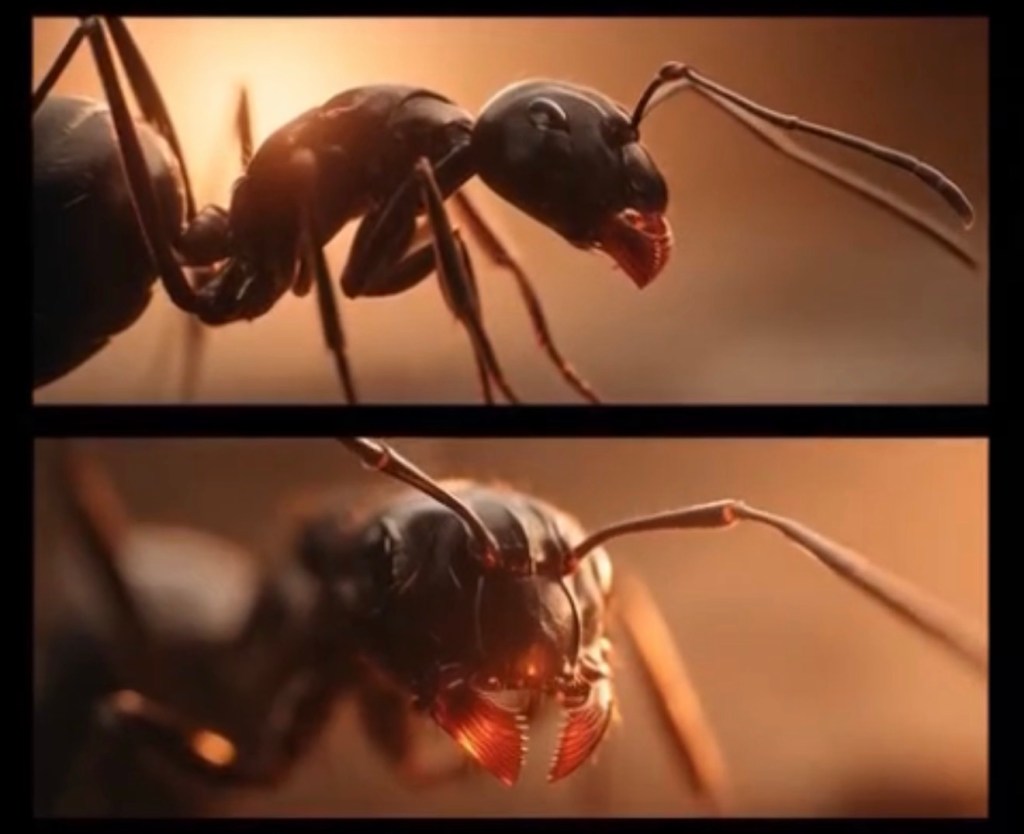
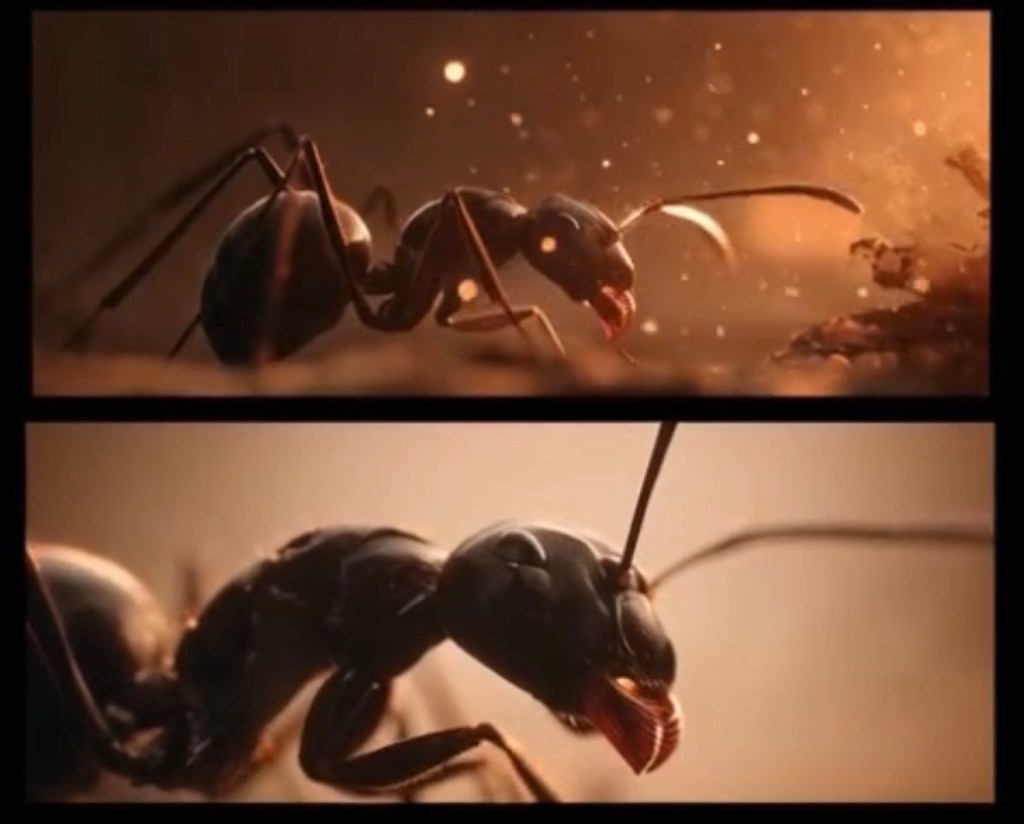
The video employs a macro-photography aesthetic with a cinematic twist, blending hyper-detailed close-ups of ants with diagrammatic, anatomical overlays. The opening sequence uses a split-screen (four vertical panels) to frame the ant from multiple angles, creating a fragmented yet cohesive view of its movement and anatomy. Later shots shift to full-frame close-ups, emphasizing the ant’s facial features (mandibles, antennae) and, eventually, a full-body anatomical diagram. The composition transitions from intimate, dynamic framing (ants in motion, dust particles) to structured, technical layouts (labeled body parts), balancing organic movement with scientific precision.
Color Palette & Lighting
A warm, earthy palette dominates: deep blacks and browns for the ant’s exoskeleton, contrasted with glowing amber and gold from backlighting that creates a halo effect around the insect. The second ant (around 8s) introduces softer orange and tan tones, while the final anatomical diagram uses muted bronze and metallic gold against a dark, moody background. Lighting is dramatic—low-key with strong backlighting—to highlight texture (the ant’s chitin, mandible serrations) and create depth. Dust particles catch the light, adding a tactile, atmospheric quality to the opening scenes.
Subject Matter & Narrative
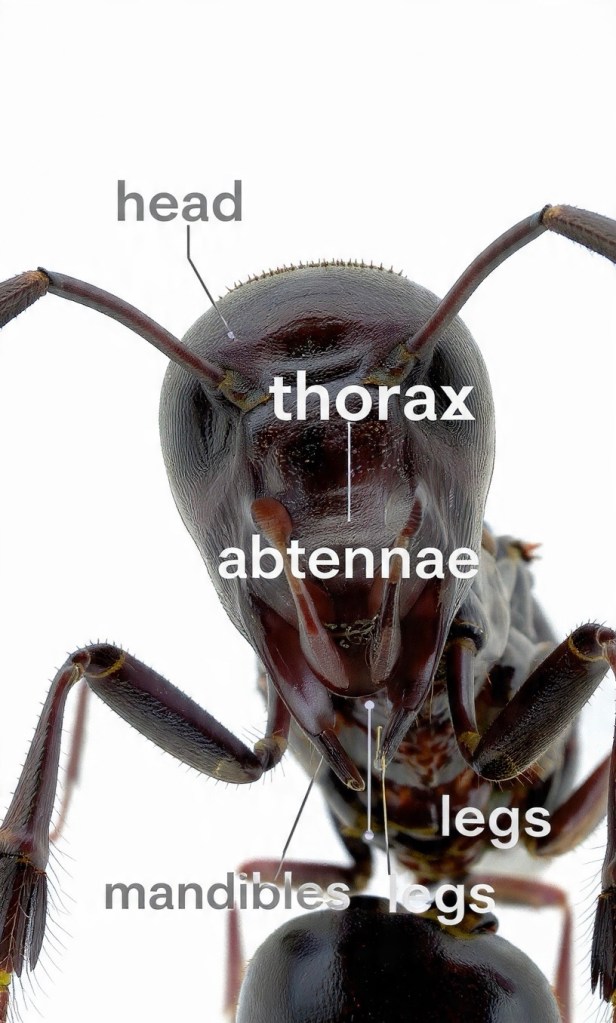
The video centers on ants, moving from a focus on their physicality (mandible movement, antenna twitching, dust displacement) to a scientific exploration of their anatomy. The first segment (0–5s) shows a dark ant in motion, its mandibles opening and closing as it interacts with its environment (kicking up dust). The middle segment (5–11s) shifts to a lighter-colored ant, overlaid with anatomical labels (e.g., “mandibles,” “antennae”) that highlight its structural design. The final segment (11–13s) presents a stylized, almost mechanical ant diagram against a technical blueprint background, suggesting a fusion of biology and engineering.
Symbolic & Thematic Elements
The ant functions as a dual symbol: of natural resilience and collective labor (a common metaphor for social organization) and of biological precision that mirrors technological design. The anatomical overlays blur the line between organism and machine, hinting at themes of biomimicry—how nature inspires human innovation. The warm, golden lighting evokes a reverence for the “small” wonders of the natural world, challenging viewers to recognize complexity in overlooked life forms.
Camera Movements & Editing Pace
Camera movements are minimal but intentional: slow pans across the ant’s body in the split-screen sequence, and a steady zoom into the ant’s face (4–5s) to emphasize its mandibles. The transition from split-screen to full-frame (5s) is abrupt, shifting focus from multiple perspectives to a singular, intimate view. The editing pace is deliberate—slow enough to let viewers absorb detail, but dynamic enough to maintain engagement. The final shift to the diagram (11s) feels like a “reveal,” moving from observation to explanation.
Mood & Atmosphere
The overall mood is reverent and curious. The opening scenes feel almost epic, framing the ant as a formidable, purposeful creature (its mandibles look like tools, its movement determined). The anatomical segments shift to a more analytical, educational tone, but the warm lighting retains a sense of wonder. The final diagram adds a futuristic, almost cybernetic edge, suggesting that nature’s designs are as sophisticated as any human technology.
Artistic & Social Themes
Artistically, the video plays with scale to elevate the mundane—turning an ant into a subject of cinematic grandeur. Socially, it invites reflection on collective effort (ants as a metaphor for community) and the importance of studying nature for innovation. The blend of organic and technical visuals also touches on the relationship between science and art, showing how close observation can reveal beauty in functionality.
“Chitin & Circuitry: A Blueprint for Resilience”
This title captures the core themes from the analysis:
- Chitin: Refers to the ant’s exoskeleton, representing nature, biology, and the physical body.
- Circuitry: Evokes the technical, diagrammatic overlays, suggesting technology, design, and interconnected systems.
- Blueprint: Connects to the final anatomical diagram, implying a plan, a design for survival or creation.
- Resilience: Speaks directly to the social/political context of the creator—an Iranian refugee—and the ant as a universal symbol of perseverance and collective strength.
The title suggests a work that explores how natural forms and social structures provide models (blueprints) for enduring and adapting in challenging circumstances.
The Republic of Small Bodies
In a white room that never belonged to him, Farid Nazifi rebuilt a country out of insects.
He had crossed borders that insisted on paperwork, checkpoints, and the geometry of permission. In Leipzig, where tramlines stitch together histories of empire, industry, and exile, he found a microscope and a silence large enough to hold memory. Under that lens, an ant became a citizen. Its body—segmented, jointed, obedient to invisible laws—looked like a map.
He named nothing correctly.
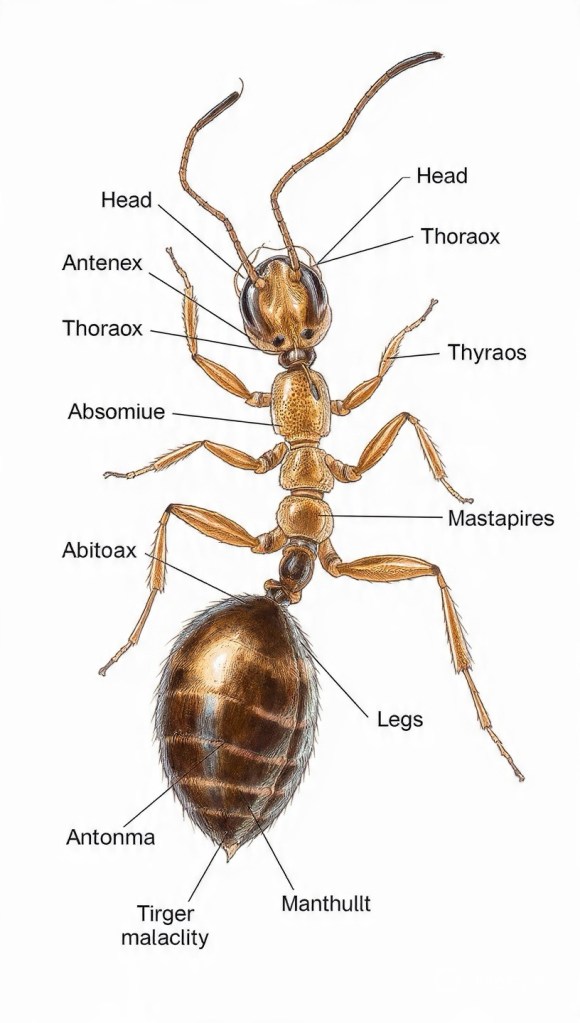
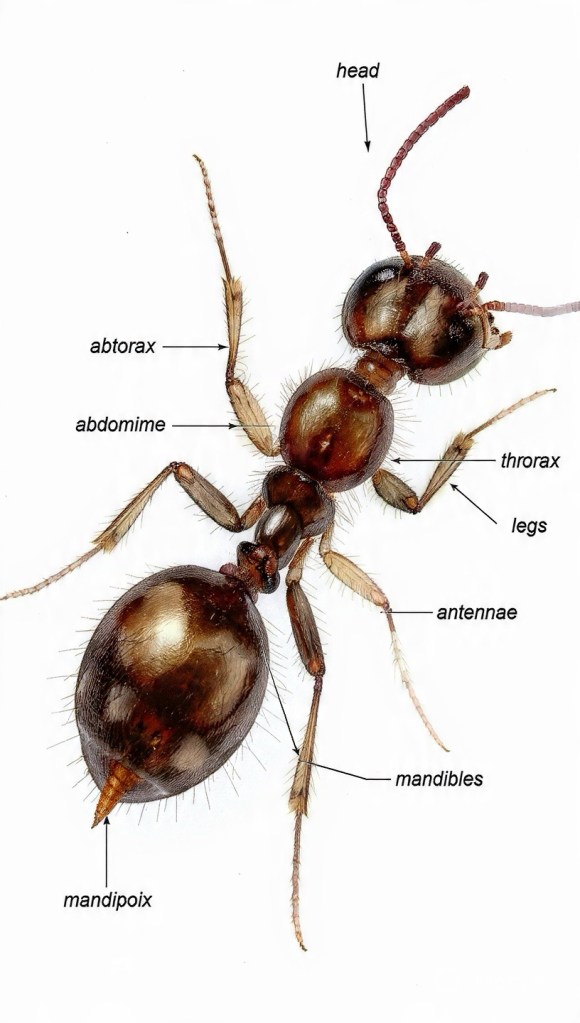
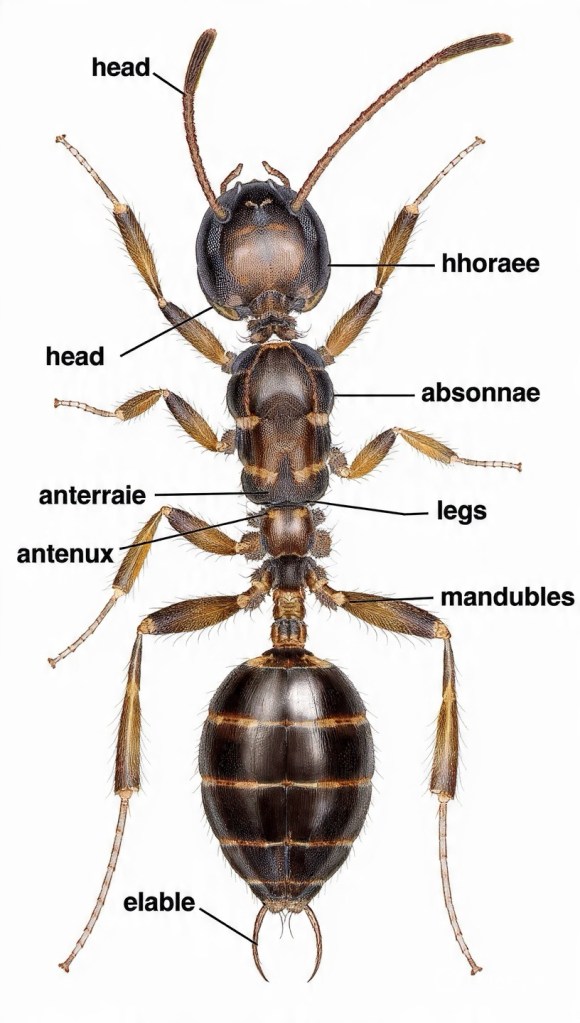
He labeled the head twice.
He misspelled thorax.
He invented organs that never existed.
The diagrams refused accuracy because accuracy had once refused him.
In the fictional state of Formicaria, every creature is both worker and witness. The head is labeled head because authority repeats itself until it becomes meaningless. The thorax is thoraox because language fractures under pressure. Antennae become antenex—translators that mishear the orders of queens and ministers. Mandibles are called mandipoix, because in the Republic of Small Bodies, tools are renamed to evade confiscation.
Each ant in the series is a refugee carrying its own anatomy like a passport:
segmented abdomen = chapters of migration legs = routes closed, reopened, closed again antennae = signals from home that arrive distorted mandibles = the right to speak or bite
The motion graphics animate these diagrams into a slow choreography: the ants assemble into parliaments, scatter into protests, march across blank backgrounds like maps erased by policy. Their bodies form borders that dissolve and reform. In one loop, an ant’s abdomen swells until it becomes a globe; in another, the head detaches and floats above the thorax like a leader without a people.
The fiction insists:
If a state can be drawn, it can be redrawn.
If a body can be mislabeled, it can be reclaimed.
If an ant can survive the collapse of its colony, so can a human.
The work imagines that somewhere beneath the white studio lights, the ants are drafting a constitution. Their clauses are simple:
Every being has the right to rename itself. Every exile is a cartographer. No border is permanent at the scale of a body.
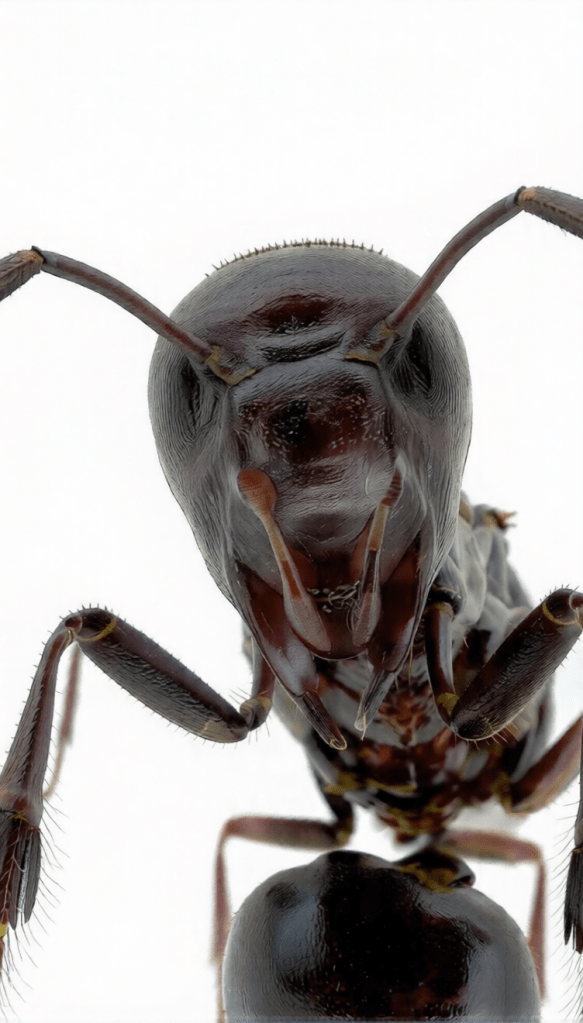
In the final frame, a close-up ant looks directly at the viewer. Its face is not menacing but administrative—an official of a micro-state issuing silent visas. The viewer becomes the foreigner. The diagram becomes a checkpoint. The mislabeled parts become a language test no one can pass.
The Republic of Small Bodies does not promise return.
It promises only motion.
=Legal Statement of the Work=Legal Statement of the Work=
Title: The Republic of Small Bodies (image series and motion graphics)
Artist: Farid Nazifi
Medium: Digital illustration, photographic compositing, typographic intervention, and motion graphics
Year: Ongoing series
Authorship and Copyright
All images, motion graphics, and associated texts are original works created by Farid Nazifi. Copyright is held by the artist unless otherwise transferred by written agreement. The works are protected under international copyright conventions, including the Berne Convention for the Protection of Literary and Artistic Works.
Moral Rights
The artist retains moral rights to attribution and integrity of the work. The work may not be altered, distorted, or used in contexts that misrepresent the artist’s intent without explicit permission.
Usage and Reproduction
Non-commercial exhibition, academic citation, or critical discussion may reference the work with proper attribution. Any commercial reproduction, distribution, NFT minting, or derivative production requires prior written consent from the artist. Motion graphics and stills may not be used for political campaigns, state propaganda, or surveillance-related technologies without explicit licensing.
Contextual Statement
The work was produced in exile and reflects themes of migration, displacement, and socio-political constraint. Any presentation of the work must acknowledge its context of creation and avoid decontextualized or exploitative framing.
Jurisdiction
In the absence of a specific licensing agreement, disputes regarding reproduction or misuse are subject to applicable copyright law within the European Union and international intellectual-property frameworks.
Contact and Licensing
Licensing, exhibition requests, and permissions must be obtained directly from the artist or their authorized representative.
Congratulations on my e-book release. 📓here you can download the e-book
 Farid Nazifi