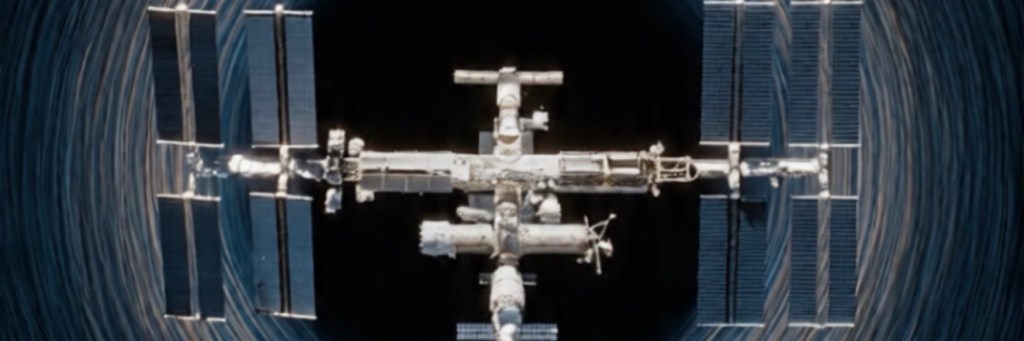
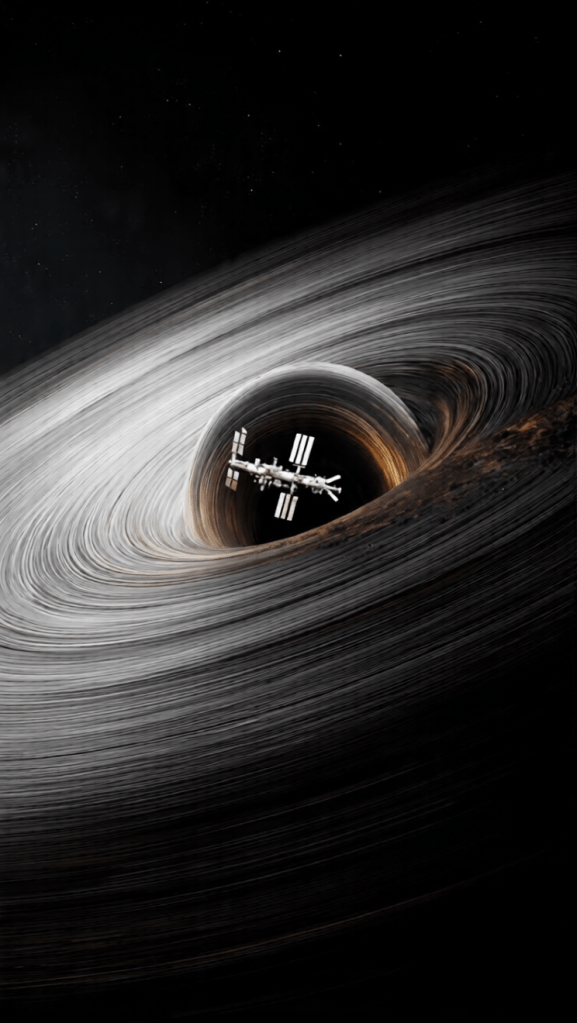
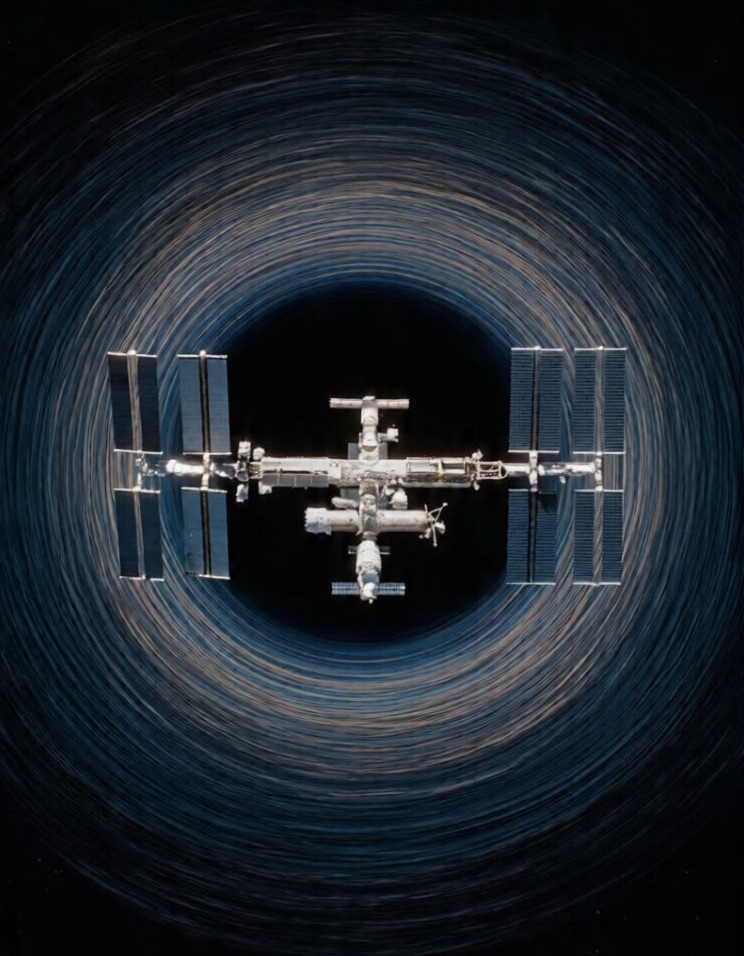
Featuring the International Space Station suspended in a black hole with time standing still, I would name it “Cosmic Stasis: The ISS in Event Horizon.”
This work presents a fascinating scientific paradox – the International Space Station, humanity’s pinnacle of orbital technology, placed within the ultimate cosmic phenomenon: a black hole. The concept of time standing still beautifully captures the theoretical physics principle that time dilation becomes infinite at the event horizon. The juxtaposition of human engineering against the raw power of spacetime curvature creates a powerful visual metaphor about our quest to understand the universe while being bound by its fundamental laws. The stationary ISS against the black hole’s gravitational pull symbolizes both human achievement and cosmic humility – we can reach for the stars, but some natural forces remain beyond our control. The frozen moment invites contemplation about our place in the cosmos and the boundaries of scientific exploration.
- A compelling title and tagline to immediately capture attention.
- Thematic sections that explore the artwork’s core concept, visual and auditory elements, and deeper philosophical questions.
- Bullet points to highlight key artistic and scientific themes.
- A concluding call to action to engage your website visitors, encouraging them to explore further or share their thoughts.
Cosmic Stasis: The ISS in Event Horizon
Where Human Achievement Meets the Gravity of History
Concept Overview
In “Cosmic Stasis: The ISS in Event Horizon,” Farid Nazifi positions the International Space Station—humanity’s most ambitious cooperative technological structure—at the threshold of a black hole, where time theoretically slows to infinity. Suspended at the event horizon, the ISS appears frozen in an impossible equilibrium: neither consumed nor free.
This motion graphics work stages a scientific paradox as a cultural metaphor. The black hole, a region where spacetime curves beyond return, becomes a visual language for displacement, rupture, and transformation. The station, built through international collaboration, stands as a symbol of collective survival and shared futurity.
For an artist who has crossed borders, languages, and political systems, this cosmic suspension resonates beyond astrophysics. It becomes a meditation on liminality.
Thematic Framework
1. Suspended Time, Suspended Identity
The event horizon is not merely an astrophysical boundary—it is a threshold of no return. Time dilation near a black hole implies that, from an external perspective, motion appears to halt.
In this work:
The ISS appears motionless against spiraling gravitational currents. Human progress confronts the limit of cosmic law. Movement exists, yet is visually imperceptible. Time stands still, yet transformation is inevitable.
This mirrors the refugee condition: physically displaced yet culturally suspended between past and future, memory and adaptation, origin and integration.
2. The ISS as Political Architecture
The International Space Station is the product of multinational collaboration—an engineered symbol of diplomacy in orbit. In Nazifi’s rendering, it becomes:
A monument to international cooperation. A fragile construct against overwhelming force. A testament to human persistence. A geopolitical object repositioned within cosmic indifference.
Placed within a black hole’s gravitational field, the ISS becomes a metaphor for institutions—national, political, cultural—subject to forces larger than themselves.
3. Visual Language & Motion
The uploaded imagery reveals three compositional modes:
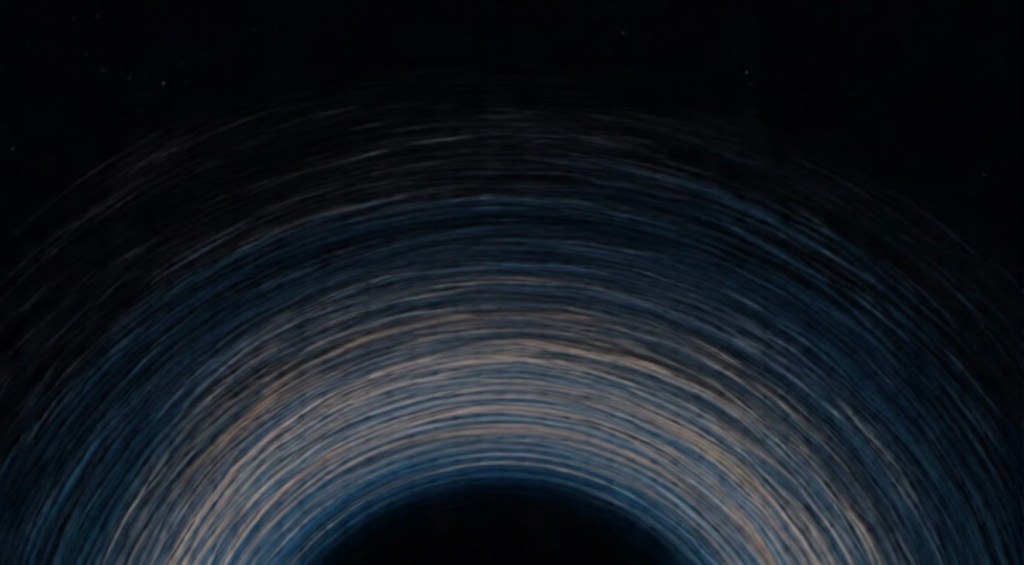
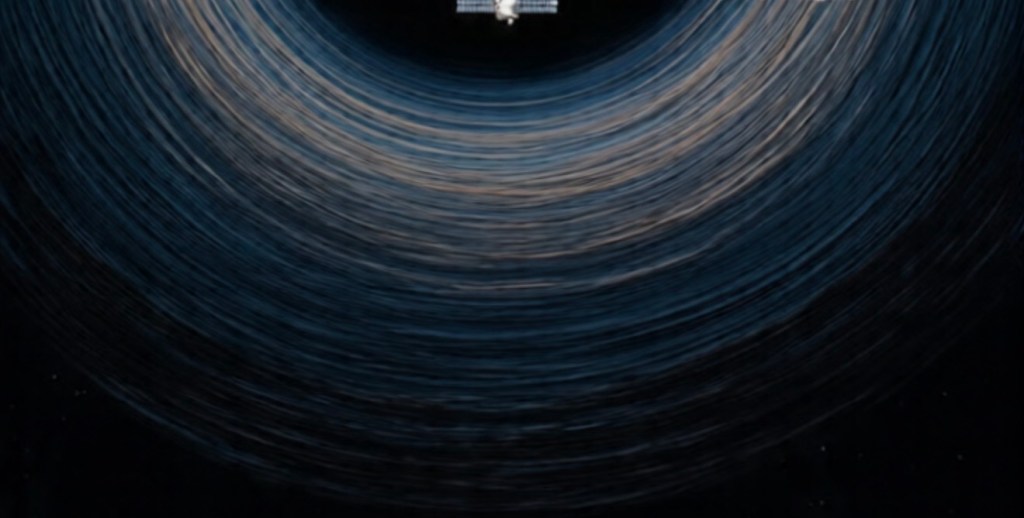
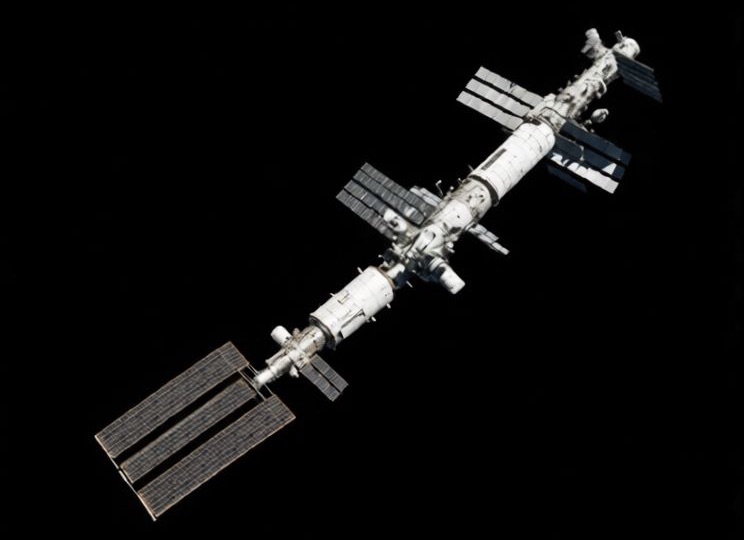
Isolation in absolute blackness – emphasizing vulnerability. Symmetrical suspension within a radiant gravitational ring – invoking ritual, cosmology, and sacred geometry. Spiral descent into luminous matter streams – suggesting inevitability and flow.
The swirling accretion disk evokes both astrophysical realism and painterly abstraction. Motion graphics techniques—rotational blur, radial light dispersion, deep contrast—produce a sensory field where stillness and velocity coexist.
If accompanied by sound design, the work would likely employ:
Low-frequency gravitational drones. Metallic resonance echoing orbital machinery. Temporal stretching or slowed harmonic structures.
The audiovisual interplay reinforces the central paradox: dynamic stasis.
Scientific and Philosophical Dimensions
Core Themes
Time dilation and relativity at the event horizon Human technological ambition vs. cosmic scale Thresholds and irreversible transformation International cooperation as fragile equilibrium Gravity as both physical and political metaphor The aesthetics of suspension
The event horizon functions here not as catastrophe, but as contemplation.
Cultural & Political Artistic Analysis
Farid Nazifi’s biography inflects the work with additional resonance. As a refugee currently residing in Leipzig, Germany, with his academic credentials officially recognized and his integration certificate completed, Nazifi embodies a trajectory of transition and institutional negotiation. His continued graduate studies in Europe situate him within the intellectual space of mobility and transnational discourse.
Within this context:
The black hole becomes a metaphor for historical rupture. The ISS symbolizes international solidarity and the promise of shared structures. Suspension evokes the bureaucratic and existential limbo often experienced in migration. The work resists collapse; it chooses tension over destruction.
“Cosmic Stasis” can thus be read as a political meditation on belonging in an era of planetary instability—ecological, geopolitical, and epistemological.
Rather than dramatizing fall, Nazifi stages endurance.
=Legal Statement=Copyright Notice=
Artist: Farid Nazifi
Current Residence: Leipzig, Germany
Academic Status: Bachelor’s degree officially translated and recognized by German authorities; holder of a German integration certificate; currently looking for a master’s program in Europe Or another Study Program Or a simple good Job Position in another field
=Copyright Notice=Legal Statement=
All images, motion graphics, conceptual frameworks, and accompanying texts associated with “Cosmic Stasis: The ISS in Event Horizon” are the original intellectual property of Farid Nazifi unless otherwise stated.
The depiction of the International Space Station is an artistic representation used for conceptual and critical commentary purposes. The work does not claim affiliation with, endorsement by, or representation of any governmental or space agency.
Unauthorized reproduction, redistribution, or commercial use of this work, in whole or in part, is prohibited without explicit written permission from the artist.
Jurisdiction & Hosting:
This website is hosted on servers located in San Francisco, California, USA. All digital content is protected under applicable international copyright law, including but not limited to U.S. Copyright Law and relevant European intellectual property frameworks.
For licensing, exhibition inquiries, or academic use, please contact the artist directly.
Congratulations on my e-book release. 📓here you can download the e-book
 Farid Nazifi