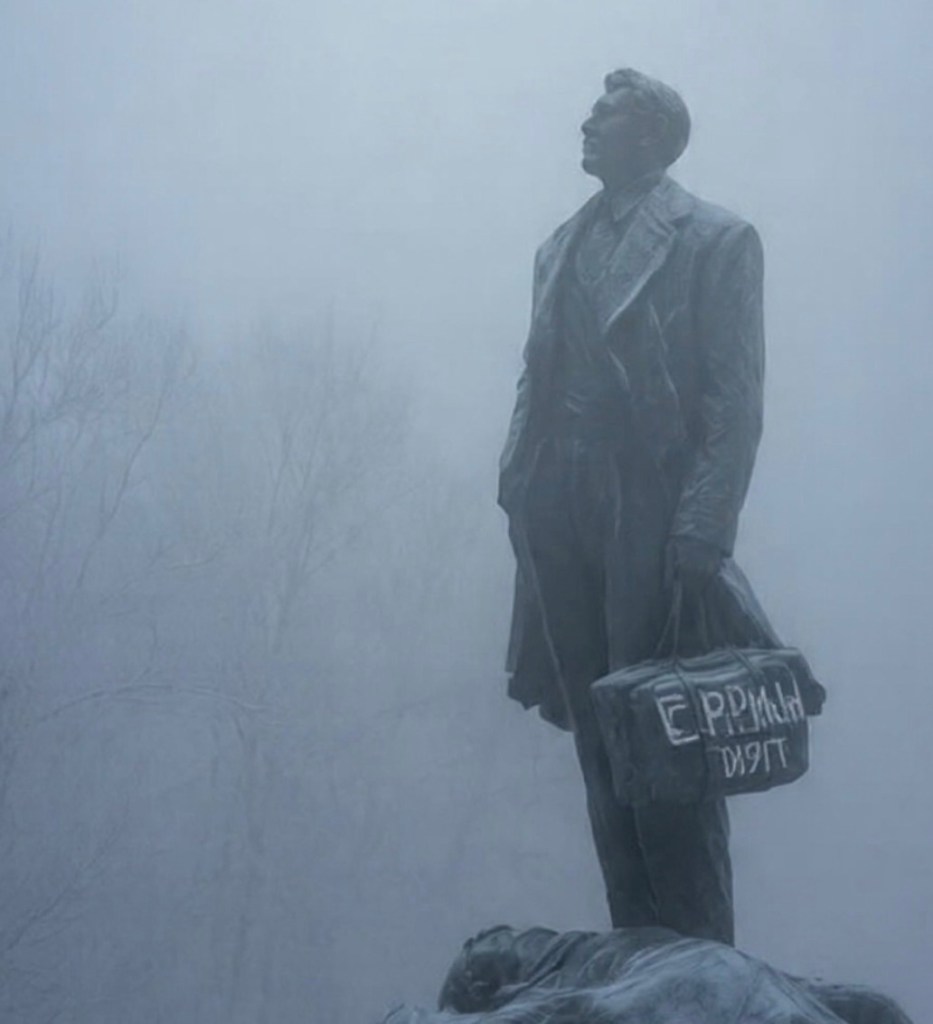
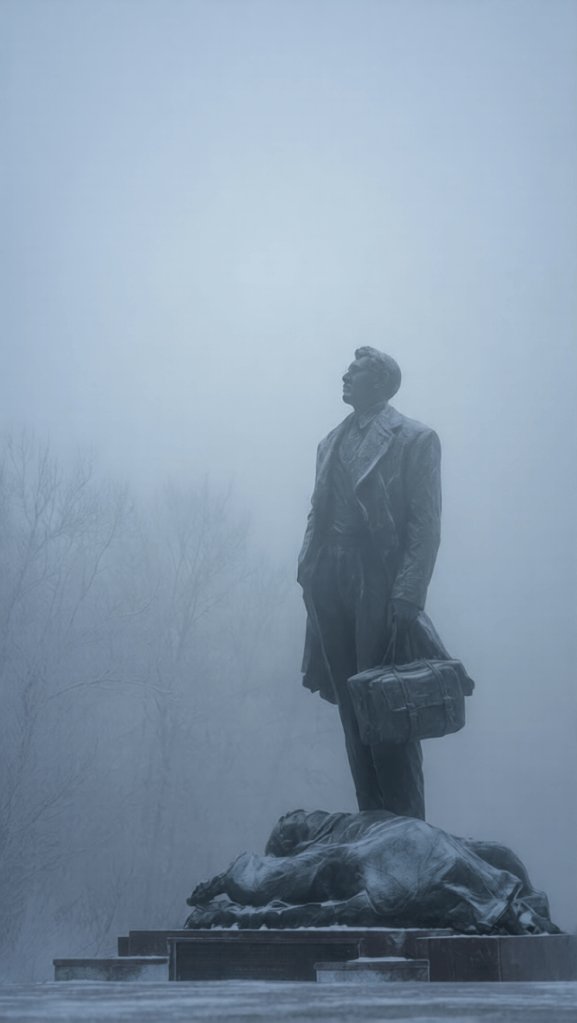
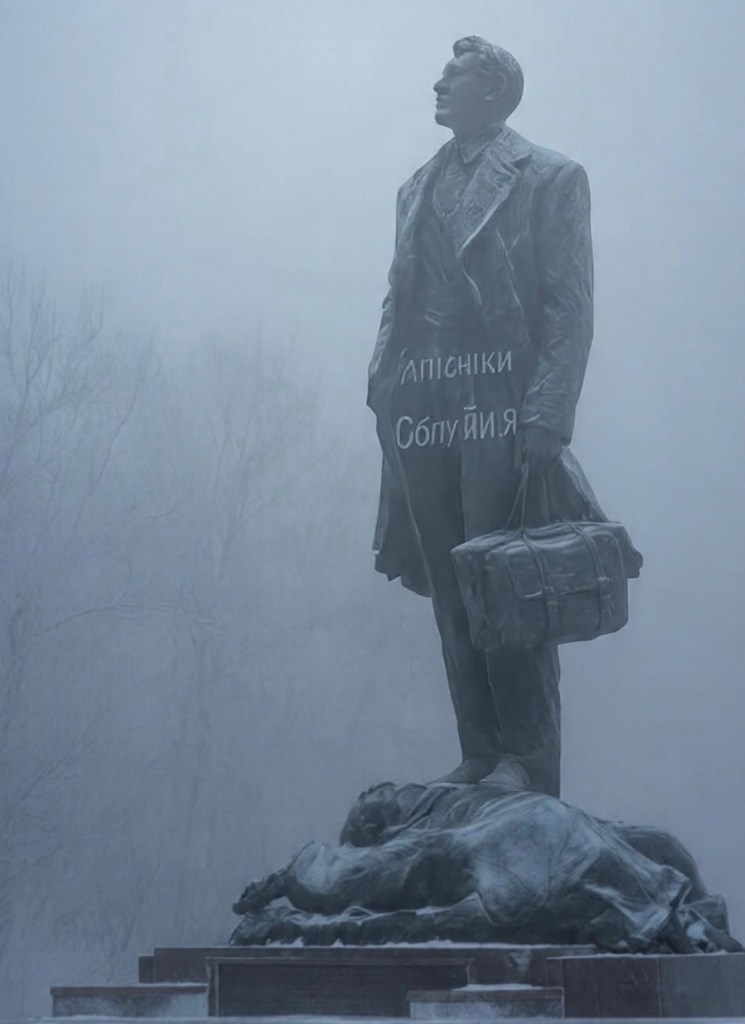
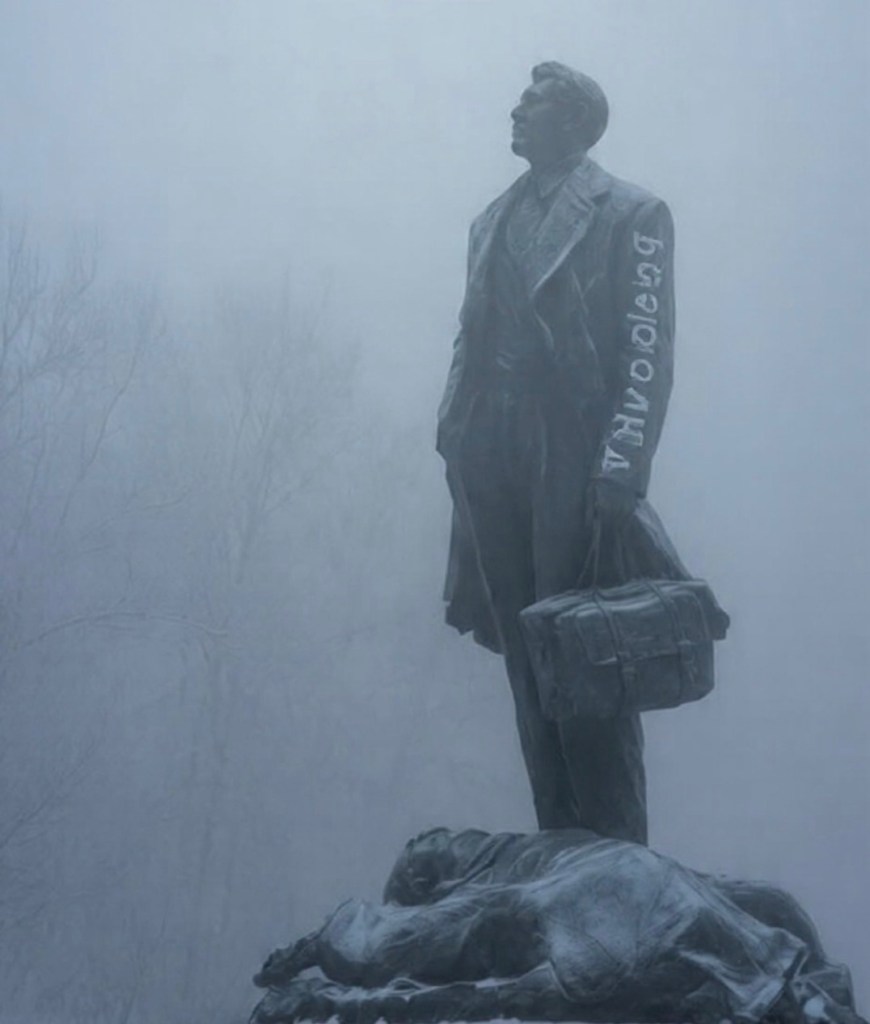
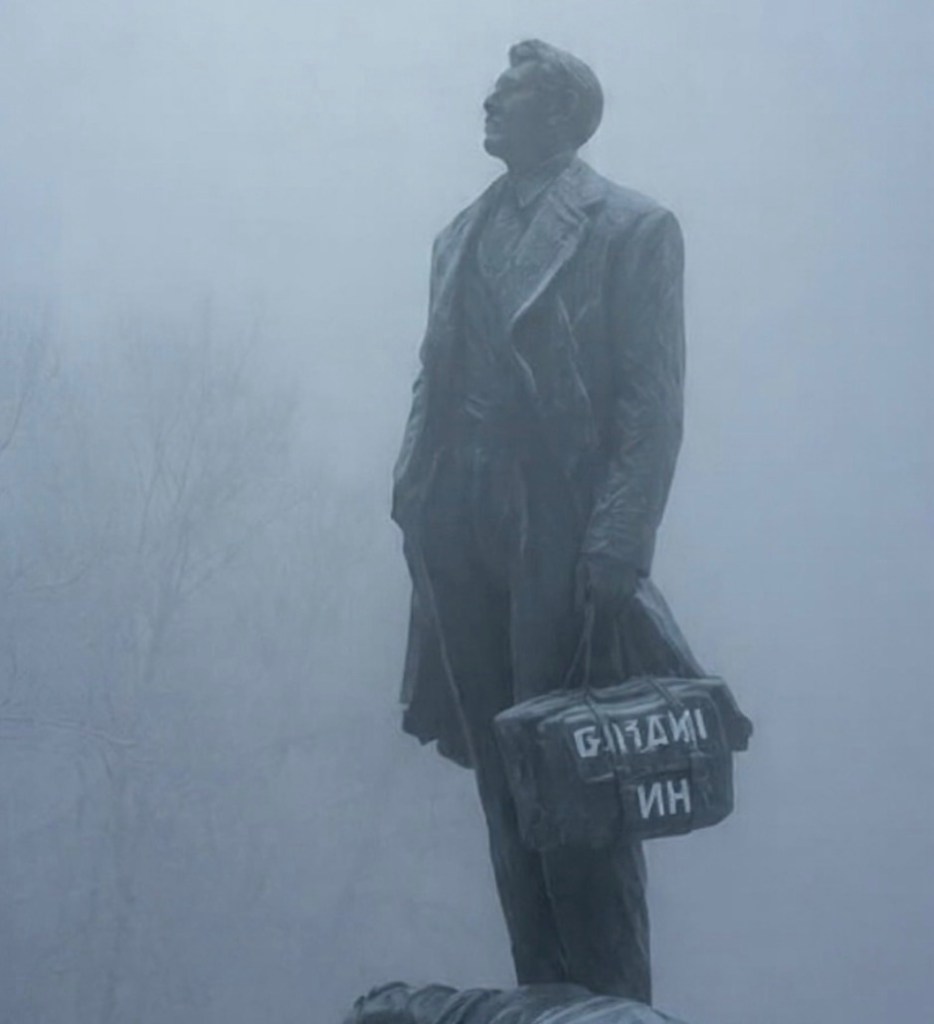
The sculpture and motion-graphics concept centers on a solitary figure standing upright in a dense, almost suffocating mist. The man’s posture—upright yet introspective, gaze lifted toward an unseen horizon—suggests both moral defiance and existential isolation. The suitcase in his hand functions as a key symbol: it is the portable life of a refugee, the archive of memory, and the burden of return. Beneath him, the recumbent body evokes sacrifice, martyrdom, and the cost of political courage. The vertical composition (standing figure) versus horizontal form (fallen body) creates a stark visual dialectic between life and death, voice and silence, witness and victim.
The fog dissolves geographical certainty, making the monument feel placeless and transnational. It could be Siberia, Europe, or a psychic interior landscape. This ambiguity mirrors the displacement of contemporary exiles: identities suspended between countries, languages, and futures. The muted blue-gray palette reinforces mourning but also endurance, as if the figure persists within a climate of repression and uncertainty.
The work resonates with the biography of its designer, Farid Nazifi—a refugee artist whose path through Poland and Germany parallels the symbolic journey embedded in the sculpture. His academic formation at Ferdows University of Mashhad and subsequent credential recognition in Saxony anchor the piece in both Iranian and European visual traditions: monumental realism, memorial sculpture, and contemporary political installation. The standing figure becomes not only a portrait of a dissident but also a mirror of the artist himself—an observer suspended between departure and return.
Political analysis
The artwork invokes the fate of Alexei Navalny as a symbolic narrative of dissent, exile, and fatal return. In doing so, it situates individual sacrifice within broader geopolitical tensions shaping Europe. The timing and context of its interpretation can be connected to the Munich Security Conference in Germany on February 13, where discussions often revolve around security, authoritarianism, democratic resilience, and the consequences of war and repression. The sculpture visually translates those policy debates into human form: the suitcase becomes the civilian cost of geopolitical conflict; the fog represents the uncertainty surrounding human rights under authoritarian systems.
The work also intersects with diasporic political mobilization in Germany, including demonstrations by Iranian exiles and the arrival of Reza Pahlavi, which have energized conversations about democratic futures in Iran. In this context, the sculpture reads as a shared memorial language across national struggles: Russian, Iranian, and broader refugee experiences converge in a single monument of resistance and mourning. Germany becomes a stage where these narratives overlap—hosting conferences on global security while simultaneously serving as a refuge for dissidents and artists displaced by war and repression.
Thus, “Return Under Fog” operates on multiple registers:
Memorial: honoring the cost of political dissent. Autobiographical: reflecting the journey of a refugee artist navigating Europe. Geopolitical: engaging with contemporary debates about democracy, exile, and state power in Europe.
The standing figure’s upward gaze ultimately suggests unresolved tension: hope without resolution, courage without guarantee. It is a monument not to closure, but to the fragile persistence of conscience in an era of displacement and political uncertainty.
Legal Statement for the Publication of the Artwork, Photographs, and Video
(related to the sculptural and motion-graphics project by Farid Nazifi)
1. Authorship and ownership
This body of work—including the sculptures, motion-graphics film, and the three accompanying photographs—is an original artistic project conceived and created by Farid Nazifi (born June 24, 1994).
All visual materials, concepts, and documentation are protected under copyright law in Germany and the European Union.
Unless otherwise stated in writing, all rights of reproduction, distribution, exhibition, and digital publication remain with the artist.
The work is presented as an artistic, documentary, and symbolic exploration of exile, memory, and political testimony. Any use by third parties (publication, exhibition, broadcast, or online distribution) requires the written permission of the artist or his authorized representative.
2. Educational and professional status
Farid Nazifi holds a bachelor’s degree in visual communications from Ferdows University of Mashhad.
His academic degree has been officially translated and recognized within the German federal state of Saxony in accordance with German credential-recognition procedures.
This recognition establishes his professional and artistic qualifications for participation in exhibitions, publications, and cultural production within Germany and the European Union.
3. Immigration and refugee-law context
The artist is a refugee who arrived in the European Union via Poland and later Germany following the outbreak of the war in Ukraine.
Under German constitutional protections—particularly Article 5 of the Basic Law (Grundgesetz)—freedom of artistic expression and freedom of publication are guaranteed to all persons residing in Germany, including refugees and individuals with pending or recognized protection status.
Accordingly:
The creation and publication of these images and the accompanying video are lawful exercises of artistic freedom. The work does not disclose confidential asylum information, protected personal data, or restricted state materials. The publication is intended for artistic, cultural, and documentary purposes and does not constitute political campaigning on behalf of any government or party. Any public display in galleries, festivals, academic settings, or online platforms falls within the scope of protected artistic activity under German and EU law.
4. Public-space imagery and personality rights
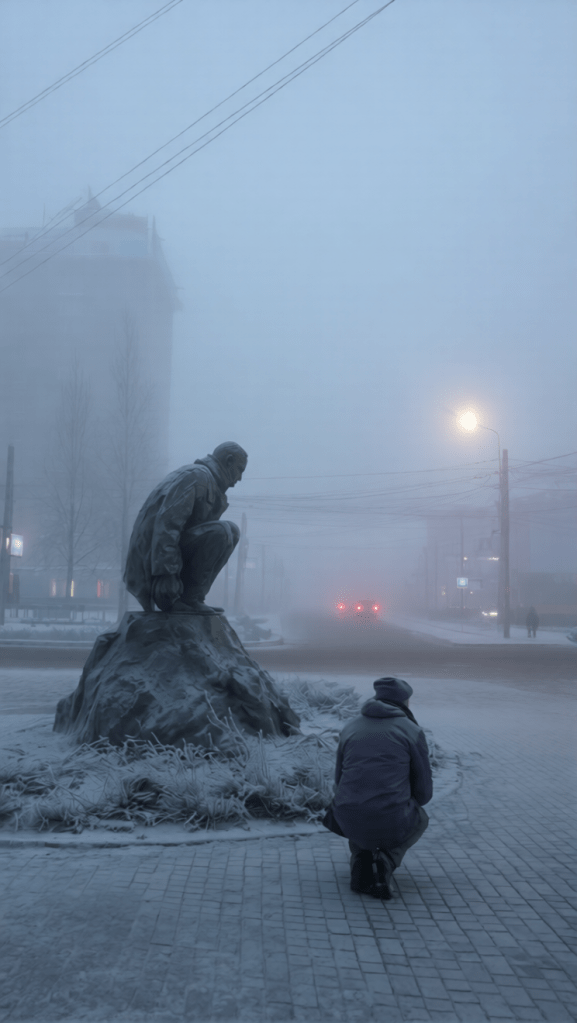
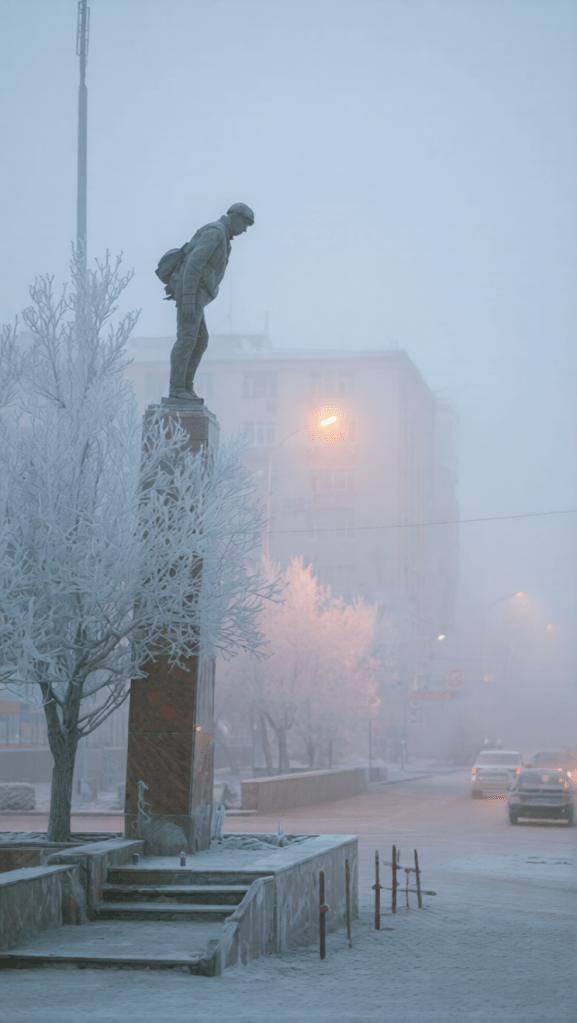
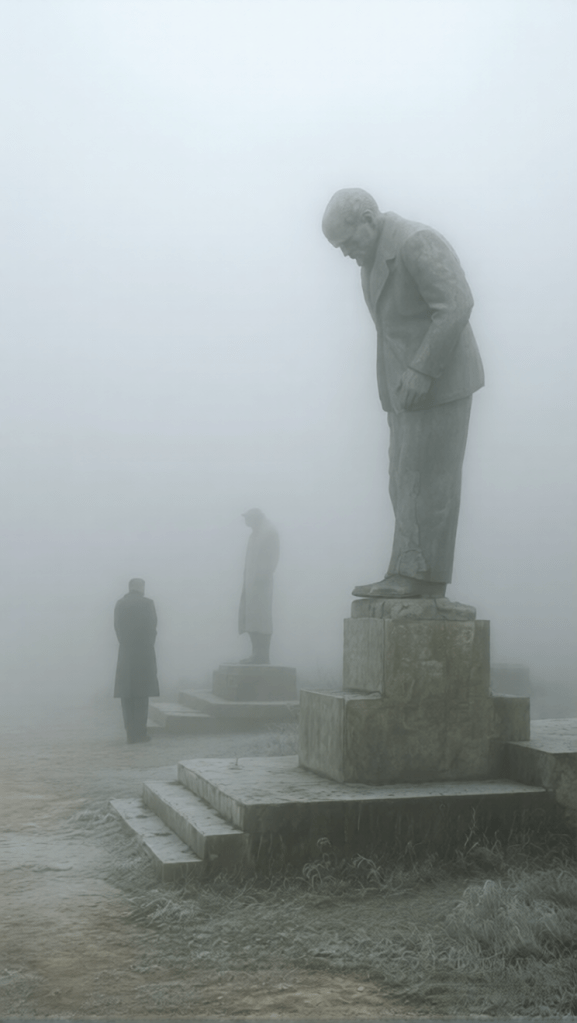
The photographs depict sculptures and public environments.
Where human figures appear, they are presented in non-identifiable or incidental ways consistent with German “Kunsturhebergesetz” (Art Copyright Act) provisions concerning images of persons in public spaces and artistic documentation.
No identifiable private individual is depicted in a manner that would violate personality rights, privacy rights, or data-protection regulations (GDPR).
If any recognizable person appears in future presentations of the work, appropriate consent or lawful artistic-documentation exceptions will apply.
5. Political and artistic expression
The artwork references themes of exile, political violence, and democratic struggle.
Such references fall under protected artistic and political expression within Germany and the European Union.
The work is not an incitement to violence, nor does it advocate unlawful activity. It is a cultural and memorial reflection aligned with international norms of artistic freedom and human-rights discourse.
6. Publication and distribution
The photographs and video may be:
Exhibited in galleries, museums, and academic institutions Published in print or digital media Submitted to festivals and cultural programs Shared on official artist platforms and portfolios
All uses must credit the artist and maintain the integrity of the work.
Unauthorized commercial exploitation or alteration is prohibited without written consent.
7. Jurisdiction
This statement is governed by the laws of Germany and applicable European Union regulations.
Any disputes regarding authorship, reproduction rights, or publication shall fall under German legal jurisdiction.
Declaration
This legal statement affirms that the creation and publication of the artwork and the three associated photographs and video are lawful under German artistic-freedom provisions, refugee-status protections, and copyright law.
It confirms the educational credentials, authorship, and legal standing of the artist within Germany and the European cultural context
= LEGAL STATEMENT = LEGAL STATEMENT =
Congratulations on my e-book release. 📓here you can download the e-book
 Farid Nazifi