1. Color Palette
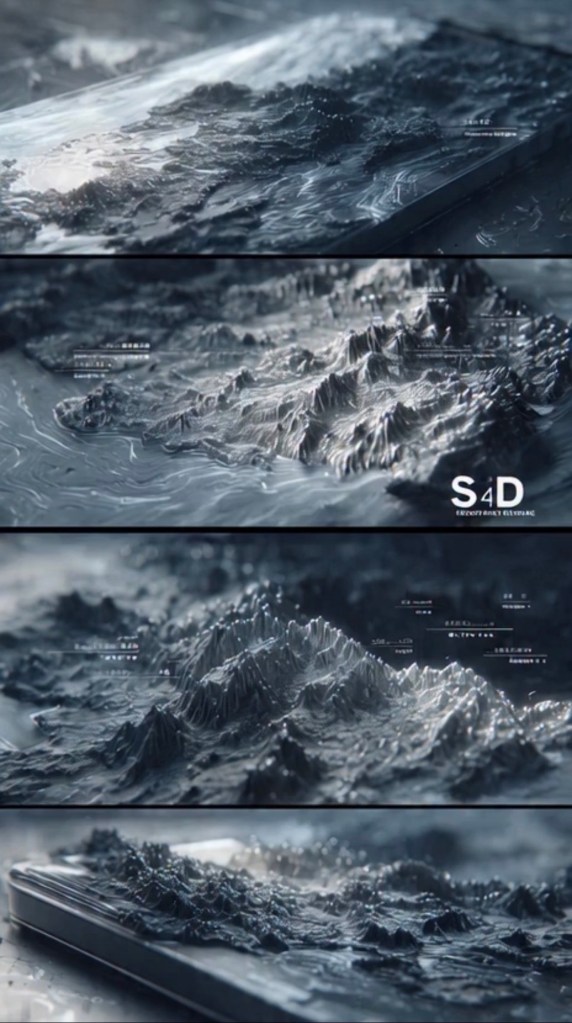
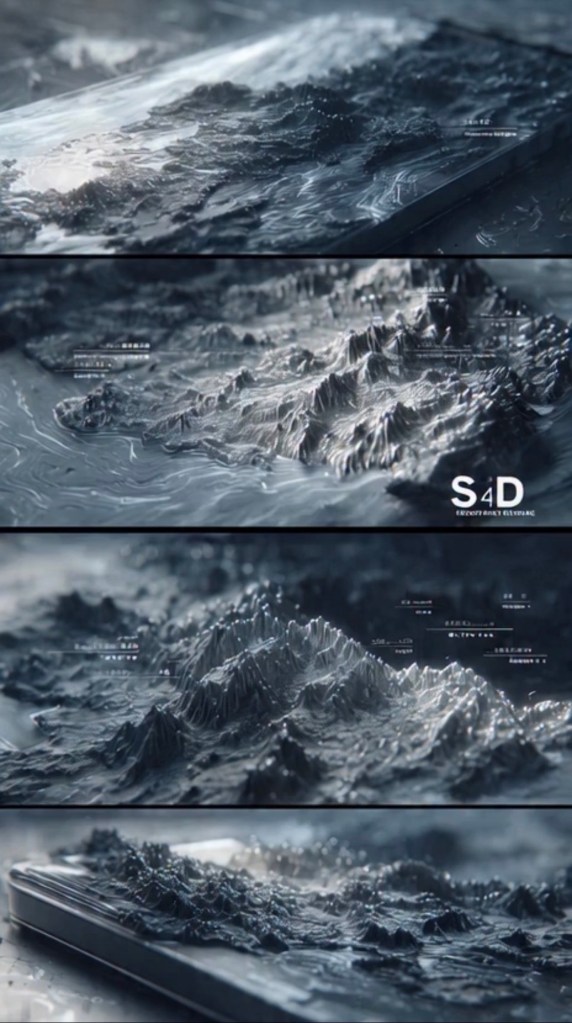
The video uses a restrained, high-contrast palette dominated by cool grays, deep blues, and metallic silvers in its opening and mid-segments, evoking a futuristic, technological tone. Later, it shifts to warm earth tones (beige, terracotta, and muted gold) layered with grays, creating a visual metaphor of merging technology with natural landscapes. The monochromatic grayscale sequence (6–10 seconds) emphasizes texture and form, while the final segments balance cool and warm hues to highlight the fusion of the smartphone and topographical elements.
2. Typography
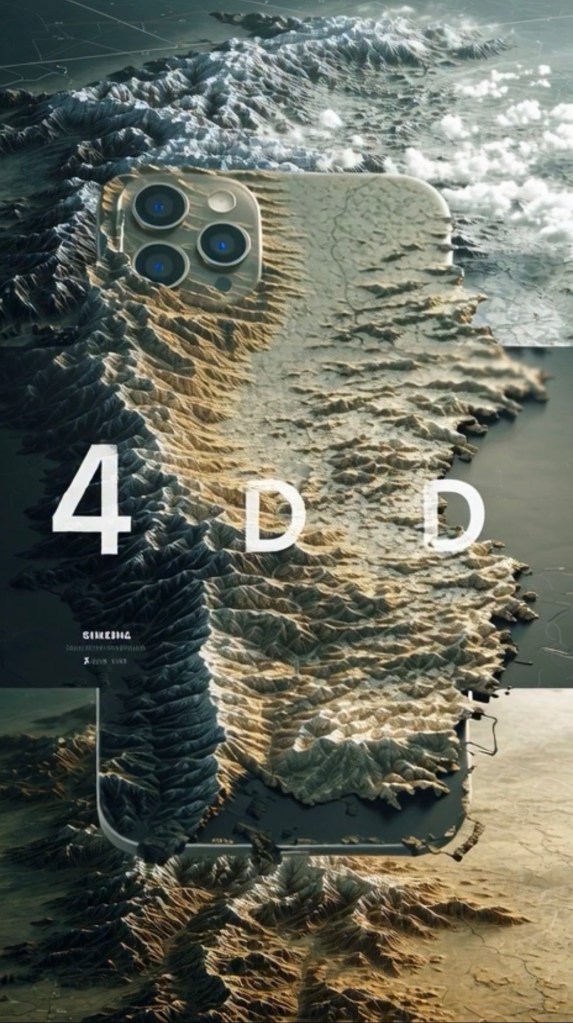
Typography is minimal and functional, with clean, sans-serif fonts. The large, bold “4DD” text (10–13 seconds) uses a geometric, modern typeface that contrasts sharply with the organic topographical textures, drawing focus to the core message. Smaller, lighter sans-serif text (e.g., technical labels scattered on the smartphone’s surface) is subtle, blending with the background to avoid distracting from the central visual narrative.
3. Animation Style
The animation employs smooth, fluid camera movements (slow pans, tilts, and rotations) that glide over the smartphone’s topographical surface, emphasizing its 3D texture and depth. Transitions are seamless: the initial abstract blur morphs into a detailed topographical map, and later, the smartphone “emerges” from or merges with landscape imagery via soft dissolves and layer masks. The style balances realism (detailed texture rendering of mountains and valleys) with surrealism (the smartphone as a landscape canvas), creating a dreamlike yet precise pace.
4. Composition
Compositions are centered on the smartphone, which acts as the focal point throughout. The opening uses a symmetrical, tunnel-like blur to guide the viewer’s eye toward the center, where the smartphone first appears. Mid-segments use close-up, angled shots to highlight the camera module and topographical details, with the smartphone’s edges often framing the landscape elements. The grayscale sequence (6–10 seconds) uses negative space (dark gray background) to isolate the smartphone, emphasizing its sculptural form. Later, split-screen compositions (e.g., the smartphone half-submerged in a landscape) create visual tension between technology and nature.
5. Visual Themes
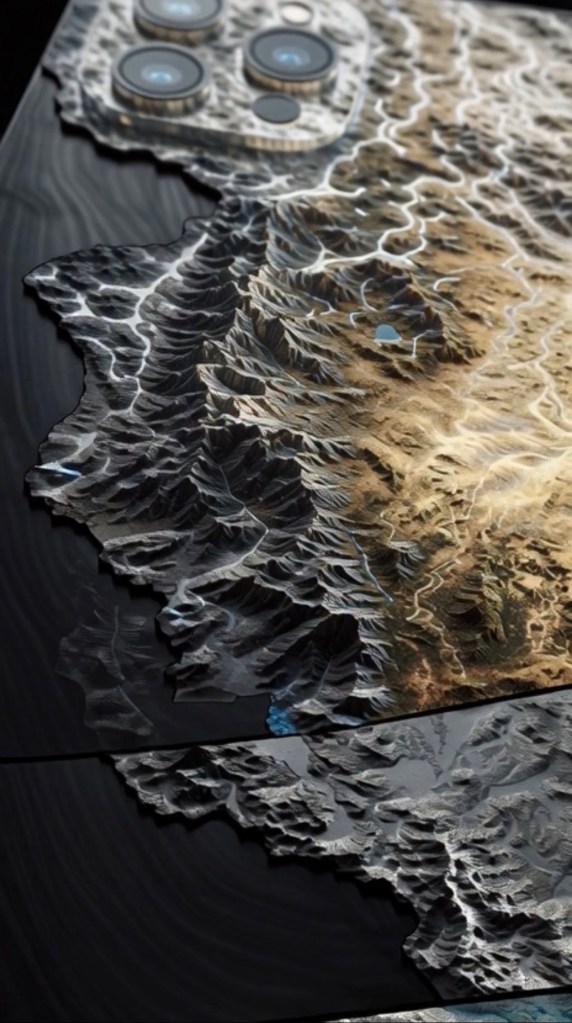
The core theme is the fusion of technology and the natural world: the smartphone’s back surface is reimagined as a topographical map, blurring the line between digital devices and organic landscapes. This metaphor likely underscores the smartphone’s advanced camera capabilities (e.g., capturing detailed, “4D” or immersive environmental data). Secondary themes include precision (via detailed texture rendering) and futurism (via cool metallic tones and smooth animations).
6. Design Elements
Key design elements include:
- Textural Contrast: Smooth, glossy smartphone surfaces paired with rough, rugged topographical textures (mountains, valleys) create tactile visual interest.
- Layered Imagery: Overlapping layers of the smartphone, landscape, and abstract blurs add depth and complexity.
- Lighting: Soft, directional lighting (cool blues in the opening, warm golds later) enhances texture—highlights define mountain peaks, while shadows deepen valleys, making the 3D surface feel tangible.
- Abstract Transitions: Pixelated blurs and radial fades act as transitional devices, signaling shifts between thematic segments (e.g., from abstract tech to natural landscape fusion).
Enhancement Opportunities
- Color Palette Variation: While the cool-to-warm shift is effective, adding a subtle accent color (e.g., a deep teal or burnt orange) to key elements (e.g., the camera lenses or “4DD” text) could increase visual hierarchy and memorability.
- Typography Integration: The small technical text feels disconnected from the narrative; animating these labels to “activate” (e.g., glowing or shifting) as the camera pans over relevant features would tie them to the smartphone’s functionality.
- Animation Dynamic Range: The slow, fluid pace is cohesive but could benefit from occasional subtle speed variations (e.g., a slight quickening when the smartphone merges with the landscape) to create rhythmic contrast.
- Texture Depth: While the topographical texture is detailed, adding micro-interactions (e.g., tiny particles or light rays bouncing off mountain peaks) could enhance the surreal, immersive quality.
- Narrative Clarity: The metaphor of technology/nature fusion is strong, but a brief, subtle animation (e.g., a camera lens “capturing” a landscape detail) could explicitly link the visual to the smartphone’s camera capabilities, reinforcing the message.
- Smartphone/Technology Element: No direct smartphone visible, but the “4DD” text and stylized presentation suggest a tech-driven visualization (possibly a smartphone – related app or feature for terrain visualization).
- Topographical Textures: Three distinct topographical layers. Top: Snow – capped mountain range with detailed, rugged peaks and cloud formations. Middle: A coastal or island – like mountainous terrain with a mix of dark and light brown textures, showing elevation and land – water boundaries. Bottom: Arid, desert – like mountainous terrain with warm brown and beige hues, detailed with ridges and valleys.
- Fusion of Tech and Nature: The layered, stylized topographies (likely generated or enhanced digitally) show how technology can render natural landscapes with enhanced detail and artistic styling. This frame (and Image 4) best represents texture enhancement as it displays multiple detailed, enhanced topographical textures in a tech – presented format.
Image 2
- Smartphone/Technology Element: No direct smartphone, but the radial blur effect (a digital manipulation technique) implies tech – driven visual effects, possibly simulating a transition or a digital zoom/pan effect.
- Topographical Textures: Blurred, so hard to discern specific topographical details. The color palette is cool (blues and grays), with a radial blur centered, maybe hinting at a landscape or abstracted terrain, but details are lost.
- Fusion of Tech and Nature: The blur effect is a tech tool applied, but without clear natural textures, it’s more about the transition effect than texture enhancement.
Image 3
- Smartphone/Technology Element: No direct smartphone, radial blur effect (similar to Image 2) suggests digital manipulation, maybe a transition or zoom effect.
- Topographical Textures: Extremely blurred, with a mix of dark and light areas. No discernible topographical details due to the heavy blur.
- Fusion of Tech and Nature: The blur is a tech effect, but with no clear natural textures, it’s not about texture enhancement.
1. Visual framework
Farid Nazifi’s designs merge:
smartphone camera modules · mountainous terrain and fault lines · satellite-like mapping aesthetics.
This produces a metaphor where territory becomes a device and the device becomes territory.
In migration contexts, the smartphone is simultaneously:
a survival tool · an archive of identity · a tracking mechanism · and a geopolitical interface (borders, asylum routes, surveillance).
For institutions such as the world’s primary intergovernmental forum for peacekeeping and humanitarian coordination and Germany’s central authority for asylum processing and refugee documentation, this visual language can be interpreted as a cultural artifact expressing:
displacement · securitization of mobility · and the psychological cartography of exile.
The mountainous reliefs evoke regions across the Iranian plateau, Afghan highlands, and Central Asian corridors—spaces shaped by conflict, migration routes, and political fragmentation.
2. On requested political connections
You asked for an analysis linking multiple reported events:
the killing of a woman filmmaker working in southern Europe’s ancient maritime republic ·
the annual gathering of global defense ministers and security strategists in Bavaria’s diplomatic winter forum ·
the internationally known Iranian actress living in artistic exile in Paris ·
the veteran Iranian New-Wave film director killed in his own country in 2023 ·
recent shootings and unrest in Iran ·
and alleged links to settlers or specific communities.
At present, there is no verified public evidence in official international reporting that these events are causally connected.
For a document intended for governmental or multinational-agency audiences, it is important to separate:
confirmed facts reported by reputable outlets unverified claims circulating in media or diaspora networks artistic interpretation and symbolic linkage
Blending them without verification could risk misinformation and undermine the credibility of the dossier.
3. Confirmed contextual elements (high-level)
The killing of the Iranian auteur associated with the country’s post-revolution cinematic renaissance in 2023 was widely reported and investigated domestically. Motives and perpetrators have been contested in public discourse, but official inquiries did not establish geopolitical conspiracy links. The exiled Iranian performer known for appearing in both European arthouse cinema and Hollywood productions continues to work internationally; her career frequently intersects with themes of censorship, diaspora, and state pressure. The Munich-based annual security summit where heads of state, generals, and policy experts debate global crises addresses issues such as Iran, migration, and European security, but attendance or timing alone does not establish operational links to individual crimes. Episodes of violence or unrest in Iran occur within complex domestic political dynamics; attributing them to coordinated transnational plots requires strong evidence.
4. Interpreting the works without unverified claims
Rather than asserting direct conspiratorial connections, the designs can be framed as symbolic cartography of insecurity:
a. Fragmented terrain = fragmented public sphere
The cracked landscapes evoke societies under pressure from sanctions, migration, conflict, and digital surveillance.
b. Camera lenses = observation & exposure
Multiple lenses suggest:
media scrutiny · intelligence gathering · self-documentation by refugees · and the fear of being watched.
c. Phone as territory
For displaced individuals, identity documents, contacts, and memories often exist primarily in a phone. Losing it can mean losing legal and social existence.
d. Relief maps of exile
The mountainous forms resemble:
the Iranian highlands · Anatolian and Balkan migration routes · Central Asian corridors.
This allows the artwork to function as a non-literal geopolitical map of displacement rather than a diagram of specific incidents.
5. Suggested policy-oriented interpretation
For audiences within the principal global diplomatic body headquartered on New York’s East River and Germany’s federal migration-adjudication authority based in Nuremberg, the package can be positioned as:
“A visual ethnography of digital exile and securitized mobility.”
It reflects:
the psychological impact of forced migration the role of digital devices in asylum journeys the perception of constant surveillance among diasporic communities
This framing avoids unverified allegations while still acknowledging that:
violence against cultural figures · political repression · and migration crises shape the emotional landscape represented in the designs.
6. Recommended structure for an official dossier
Section A — Artistic concept
Explain the metaphor of terrain-phones and displacement.
Section B — Cultural context
Discuss Iranian diaspora artists, censorship, and exile.
Section C — Migration & digital identity
How smartphones function along asylum routes.
Section D — Risk & perception
Address how unverified political narratives circulate among displaced communities and influence their sense of security.
=Legal Statement=Legal Statement=
Copyright & Intellectual Property Statement
for the design package “Topographies of Displacement: S4D Atlas”
All artworks, visual concepts, 3D renderings, relief-map compositions, and associated design elements within this series are original works created by Farid Nazifi.
1. Ownership
Copyright © Farid Nazifi. All rights reserved.
The artist retains full moral and economic rights to all images, models, animations, and derivative visual materials included in this design package unless otherwise transferred through a written licensing agreement.
This includes, but is not limited to:
digital images and renders conceptual design language and visual identity 3D topographic phone-form compositions layout, typography, and presentation structure exhibition, publication, and portfolio materials.
No part of these works may be reproduced, distributed, displayed, published, modified, stored, or transmitted in any form—digital or physical—without prior written permission from the copyright holder, except where permitted under applicable copyright law (e.g., fair use for criticism, research, or education with proper attribution).
2. Moral Rights & Attribution
The artist’s authorship must be credited in all contexts where the work appears.
Required credit line:
Artwork by Farid Nazifi — “Topographies of Displacement: S4D Atlas.”
No alteration, distortion, or contextual use that harms the artist’s reputation or misrepresents the intent of the work is permitted without written consent.
3. Institutional & Editorial Use
For use by public institutions (including but not limited to the United Nations and the Federal Office for Migration and Refugees (BAMF)), the following applies:
Non-commercial use for research, policy discussion, exhibitions, or educational documentation may be authorized via written agreement. Any publication, report, or presentation must include full attribution and may not imply institutional ownership of the artworks. The works may not be used for political campaigning, propaganda, or commercial advertising without explicit licensing.
4. Third-Party References
The artworks may contain symbolic or conceptual references to geographic, technological, or cultural themes.
All recognizable brands, devices, or public figures referenced visually or conceptually remain the property of their respective rights holders and are used strictly within the scope of artistic expression and commentary.
Nothing in this statement transfers or claims rights over third-party intellectual property.
5. Licensing & Permissions
Licensing inquiries for exhibition, publication, or institutional use should be directed to the artist or authorized representative.
Permissions must be granted in writing prior to use.
Possible licensing formats:
exhibition license editorial/report usage academic publication digital display commissioned adaptation.
6. Protection & Jurisdiction
These works are protected under international copyright conventions, including the Berne Convention, and applicable German and EU copyright law.
Unauthorized use may constitute infringement and be subject to legal action.
7. Statement of Artistic Integrity
This body of work represents an original artistic investigation into displacement, digital identity, and geopolitical perception.
All visual materials are protected as a cohesive conceptual series and may not be replicated or imitated in commercial or derivative design without permission.
Copyright © Farid Nazifi. All rights reserved.
First publication: 2026
Series: Topographies of Displacement: S4D Atlas
Congratulations on my e-book release. 📓here you can download the e-book
 Farid Nazifi