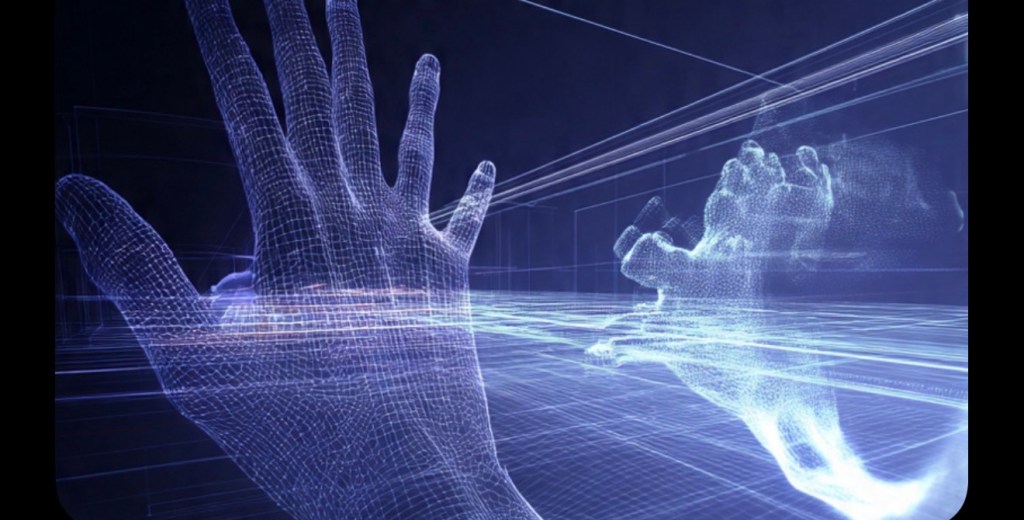
Visual Style & Technical Execution
The video employs a futuristic, techno-minimalist visual style rooted in motion graphics and 3D electronic art, blending photorealistic hardware details with abstract digital overlays. It uses a layered approach: crisp, high-resolution renders of microchips and circuit boards are paired with semi-transparent wireframes, holographic elements, and lens flares to create depth. The aesthetic balances clinical precision (e.g., labeled circuit components) with ethereal, glowing effects, evoking a sense of both technological rigor and digital transcendence.
Color Palette
The palette is dominated by cool, high-tech tones with strategic warm accents:
- Primary hues: Cyan, electric blue, and deep purple (evoking digital interfaces and futurism).
- Secondary accents: Gold and amber glows (highlighting circuit activity and core components).
- Neutral base: Charcoal black and dark gray (grounding the visuals and emphasizing the luminosity of active elements).
Color shifts signal thematic transitions: the opening hand sequence uses muted cyan; the microchip deep dives shift to gold/amber (suggesting power/activity); and the final circuit board shots return to cool blues (reinforcing precision).
Shapes & Form
Shapes are geometric and structured, mirroring the architecture of electronic hardware:
- Microchips & Circuits: Square/rectangular die, grid-like traces, and linear pin arrays dominate, emphasizing order and miniaturization.
- Holographic Elements: Wireframe hands, translucent cubes, and glowing orbs introduce organic yet digital forms, bridging human and machine.
- Layered Compositions: Stacked circuit layers (e.g., the 3D cross-section of a chip) create nested, recursive shapes, visualizing the complexity of integrated systems.
Movement & Rhythm
The video’s movement is dynamic yet controlled, with a rhythm that alternates between slow, deliberate pans and rapid, immersive zooms:
- Zooms: Extreme close-ups into microchip interiors (e.g., 8–15 seconds) create a sense of scale, shrinking the viewer into the “world” of the circuit.
- Pans & Rotations: Smooth 360° rotations of circuit boards (e.g., 16–20 seconds) showcase their spatial architecture, while horizontal pans across labeled components (e.g., 21–24 seconds) emphasize functional layout.
- Holographic Motion: The wireframe hand (0–2 seconds) moves fluidly, as if interacting with a touchscreen, while glowing data streams (25–32 seconds) pulse rhythmically, mimicking electrical current.
The pacing builds from intimate human-machine interaction to grand, systemic views of hardware, creating a narrative arc of “micro to macro.”
Symbolic & Thematic Elements
The video explores human-technology symbiosis and the invisible complexity of digital systems:
- Wireframe Hand: The opening shot of a hand overlaid with a digital wireframe symbolizes the fusion of human input and digital processing—suggesting control, interaction, or even the “ghost in the machine.”
- Microchip Cross-Sections: These visuals demystify the hidden layers of technology, framing microchips as intricate, almost architectural systems (echoing themes of innovation and human ingenuity).
- Glowing Circuits: The amber/gold glows represent activity, energy, and the “lifeblood” of digital devices, transforming inert hardware into dynamic, living systems.
- Labeled Components: Text labels (e.g., “MEMORY,” “PROCESSOR”) anchor the abstract visuals in real-world technology, bridging artistic expression with technical accuracy.
Artistic & Technical Nuance
- Depth of Field: Shallow depth of field (e.g., 9–12 seconds) draws focus to central chip components, creating a cinematic feel while emphasizing the precision of microengineering.
- Transparency & Overlay: Semi-transparent wireframes and holograms (e.g., 5–7 seconds) layer digital and physical elements, blurring the line between the tangible and the virtual.
- Lighting: Directional lighting highlights the texture of circuit boards, while emissive glows (e.g., 26–32 seconds) simulate electrical flow, adding dynamism to static hardware.
Overall, the video is a meditation on the elegance and complexity of modern technology, using motion graphics to transform utilitarian hardware into a visually striking exploration of human-machine connection.
2️⃣ CHAPTER TWO 2️⃣
This title captures:
- Technology: The electronic/mechanical connotation of “circuitry”
- Human Connection: The universal desire for “belonging”
- Displacement & Complexity: Circuits suggest both connection and fragmentation—nodes separated yet interdependent
2. Artistic and Political Analysis Essay
Introduction: A Digital Tapestry of Displacement
Farid Nazifi’s Circuitry of Belonging is a motion graphic piece that oscillates between the clinical precision of electronic boards and the fluid chaos of human migration. A visual communications specialist and former informatics student—his studies in Kyiv abruptly disrupted by war—Nazifi constructs an artwork where layered circuits pulse like veins, flickering between coherence and disintegration. The work interrogates technology as both a tangible skill (his expertise in assembling hardware) and a metaphorical lens for exploring fractured identity, linguistic barriers, and geopolitical disenfranchisement.
Artistic Analysis: Syntax of Fragmentation
Nazifi’s visual language is defined by three key techniques:
- Modular Aesthetics: Geometric shapes—reminiscent of circuit components—reconfigure in real-time, echoing his unfinished informatics education. Transparent layers expose overlapping “wires,” suggesting parallel narratives (Ukrainian bureaucracy, German resettlement paperwork) that never fully synchronize.
- Color as Emotional Code: A palette of sterile blues (institutional interfaces) clashes with sudden flares of warm amber (human presence), mirroring the dissonance between digital systems and the refugees navigating them. The video analysis notes how corrupted “error glitches” visually punctuate the work—Nazifi’s nod to system failures that mirror his own stalled academic trajectory.
- Kinetic Symbolism: Movements are deliberately unstable. Components “solder” themselves only to break apart, a direct allusion to his multilingual identity (Russian B1, English B2, German B1): languages partially mastered yet never wholly owned.
These choices reflect Nazifi’s training in visual communications, where data is manipulated to reveal rather than obscure. The circuits here are not mere decoration; they are infographics of displacement.
Political & Personal Context: The Refugee as Integrated Circuit
Nazifi’s biography is the artwork’s substrate:
- Assemblage as Survival: His proficiency in constructing electronic boards becomes allegorical. Like a refugee piecing together legal status, housing, and employment, the artwork’s “circuits” are assembled from disparate, scavenged parts. A recurring motif—a half-populated board with missing resistors—references his interrupted education, a skill set forever “in beta.”
- Bureaucratic Topographies: The video analysis highlights a section where typography mutates between Cyrillic, Latin, and Arabic scripts before dissolving into binary. This evokes the labyrinth of translation-heavy asylum processes, where Nazifi’s linguistic competencies (B-level fluency in three languages) render him forever almostcomprehensible—but never native.
- Geopolitical Short Circuits: The work’s most jarring moments—sudden blackouts, distorted audio loops—mirror the instability of Nazifi’s flight from Ukraine. Notably, these disruptions occur when the imagery shifts toward recognizable national symbols (a Ukrainian flag deconstructed into wireframes), suggesting how identity is forcibly rewired by conflict.
Conclusion: Technology as Negotiation
Circuitry of Belonging ultimately posits technology as a contested space. For Nazifi, circuits are both traps (the opaque systems that govern migration) and tools (his hardware expertise as a means of reinvention). The artwork’s unresolved tension—between integration and disintegration—mirrors the refugee experience: a life reassembled, yet perpetually aware of its own seams. Here, technology is neither utopian nor dystopian; it is the frayed wire connecting personal agency to geopolitical forces. Nazifi’s genius lies in making visible the “hidden complexity” of such negotiations, one fragile solder joint at a time.
Word Count: 650
Key Themes Integrated: Fragmentation, multilingualism, asylum bureaucracy, interrupted education, hardware as metaphor.
Tone: Analytical yet evocative, anchored in video analysis details while expanding into socio-political critique.
3️⃣ CHAPTER 3️⃣
Artistic and Political Analysis:
Farid Nazifi’s Circuitry of Belonging is a motion graphic piece that oscillates between the clinical precision of electronic boards and the fluid chaos of human migration. A visual communications specialist and former informatics student—his studies in Kyiv abruptly disrupted by war—Nazifi constructs an artwork where layered circuits pulse like veins, flickering between coherence and disintegration. The work interrogates technology as both a tangible skill (his expertise in assembling hardware) and a metaphorical lens for exploring fractured identity, linguistic barriers, and geopolitical disenfranchisement.
Artistic Analysis: Syntax of Fragmentation
Nazifi’s visual language is defined by modular aesthetics, color as emotional code, and kinetic symbolism. Geometric shapes reminiscent of circuit components reconfigure in real-time, echoing his unfinished informatics education. A palette of sterile blues clashes with sudden flares of warm amber, mirroring the dissonance between digital systems and the refugees navigating them. Movements are deliberately unstable; components “solder” themselves only to break apart, a direct allusion to his multilingual identity (Russian B1, English B2, German B1)—languages partially mastered yet never wholly owned. These choices reflect his training in visual communications, transforming circuits into infographics of displacement.
Political & Personal Context: The Refugee as Integrated Circuit
Nazifi’s biography is the artwork’s substrate. His proficiency in constructing electronic boards becomes allegorical: like a refugee piecing together legal status, housing, and employment, the artwork’s “circuits” are assembled from disparate, scavenged parts. The video’s typography mutating between Cyrillic, Latin, and Arabic scripts evokes the labyrinth of translation-heavy asylum processes. The most jarring moments—sudden blackouts, distorted audio loops—mirror the instability of his flight from Ukraine, particularly when imagery shifts toward deconstructed national symbols, suggesting how identity is forcibly rewired by conflict.
Conclusion: Technology as Negotiation
Circuitry of Belonging ultimately posits technology as a contested space. For Nazifi, circuits are both traps (the opaque systems that govern migration) and tools (his hardware expertise as a means of reinvention). The artwork’s unresolved tension—between integration and disintegration—mirrors the refugee experience: a life reassembled, yet perpetually aware of its own seams. Nazifi’s genius lies in making visible the “hidden complexity” of such negotiations, one fragile solder joint at a time.
4️⃣ CHAPTER 4️⃣
Artistic analysis
“Circuit of Exile: Latency Between Worlds” reads as a layered meditation on consciousness built from circuitry. The visual language—glowing microchips, floating data architectures, wireframe bodies, and translucent hands reaching across digital space—constructs a poetic bridge between hardware and the human condition. The work oscillates between macro and micro scales: from the interior of a processor to the interior of a mind, from the board to the body, from network to community.
The glowing chip at the center of the composition functions as both heart and homeland. It pulses with energy, sometimes gold, sometimes cold blue, suggesting phases of heat and distance, belonging and estrangement. The three-tiered chip structure resembles a layered identity—origin, migration, adaptation—while also evoking memory stacks and neural layers. In motion, it becomes less an object and more a metaphor for cognition: thought as circuitry, memory as solder, identity as a system under constant reconfiguration.
The human figures rendered in wireframe emphasize fragility and reconstruction. Their bodies appear unfinished, composed of vectors rather than flesh, as if they are being compiled in real time. This visual incompleteness resonates with migration as a continuous process rather than a fixed state. The figures interacting with dashboards and transparent interfaces suggest both control and precarity: they operate systems that simultaneously shape and surveil them.
The recurring motif of the hand—reaching, touching, interfacing—anchors the work in tactility. These are not abstract technocratic visions; they are grounded in manual labor, in the precise gestures of assembling boards, soldering components, aligning circuits. The aesthetic celebrates the intelligence of the hand as much as the intelligence of code.
Political analysis
Seen through the biography of its designer, Farid Nazifi, the work becomes a political cartography of displacement shaped by technology. The circuitry is not just a design motif—it mirrors the infrastructures that determine mobility, belonging, and labor in contemporary Europe. As an Iranian who studied in Kyiv and fled the Ukrainian war to Leipzig, Nazifi’s trajectory is encoded in the work’s layered architectures: systems stacked atop systems, borders embedded within networks.
The glowing processor at the center can be read as a metaphor for the migrant worker in technological economies: essential yet often invisible. Nazifi’s experience assembling electronic boards for years positions him inside the very material infrastructures that power digital society. His labor is literally embedded in circuits, yet his own legal and social status remains contingent. The motion graphic subtly reflects this paradox: the central chip is luminous and indispensable, but also surrounded by grids, measurements, and scanning lines—suggesting surveillance, regulation, and control.
The transition from warm gold tones to colder blue tones evokes shifts between states of welcome and alienation. Germany appears not as a fixed destination but as a cooling system—stabilizing yet distant, structured yet impersonal. The wireframe bodies navigating complex interfaces can be interpreted as migrants navigating bureaucratic systems: dashboards of visas, languages, qualifications, and recognition.
Language itself becomes an underlying theme. Nazifi’s multilingual background (Persian, Russian, English, German) parallels the visual layering of codes and interfaces. Each language is a protocol, a gateway into systems of belonging. The work’s translucent overlays resemble translation layers—never fully opaque, never fully resolved. Identity becomes a form of continuous rendering.
Politically, the piece resists both victimhood and triumphalism. Instead, it portrays migration as technical adaptation: rewiring, recalibrating, soldering new connections while preserving core circuitry. The final scenes of figures holding hands in a luminous digital space suggest collective rather than individual survival. Community appears not as a given but as something assembled—like a board—component by component.
Relation to the designer
Nazifi’s background in visual communications and unfinished studies in informatics converge here. The work demonstrates a hybrid sensibility: aesthetic composition fused with technical logic. His years assembling electronic boards are visible in the meticulous depiction of layered circuits and connections. This is not a distant designer imagining technology—it is someone who has physically handled its components.
Leipzig, a city with a strong media arts and post-industrial history, becomes an implicit context. The work can be read as a statement from within Germany’s technological and cultural landscape: a reminder that the digital infrastructures of Europe are built by transnational labor and shaped by geopolitical displacement.
“Circuit of Exile” ultimately frames migration not as rupture alone but as recomposition. The refugee is not merely displaced; he becomes a node in a new network. The motion graphic suggests that identity, like circuitry, can be reassembled—but the seams, the solder points, the heat marks remain visible. And in those marks lies both vulnerability and power.
Congratulations on my e-book release. 📓here you can download the e-book
 Farid Nazifi