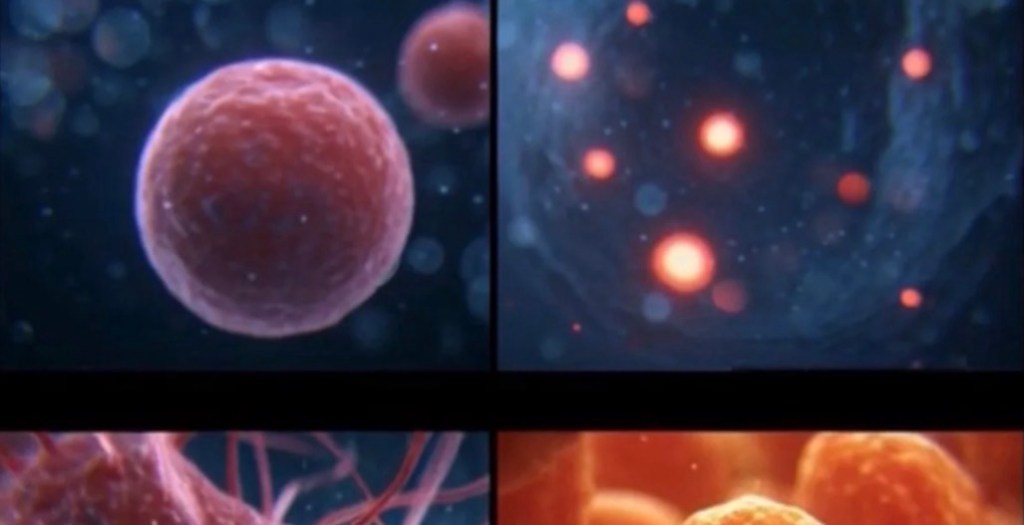
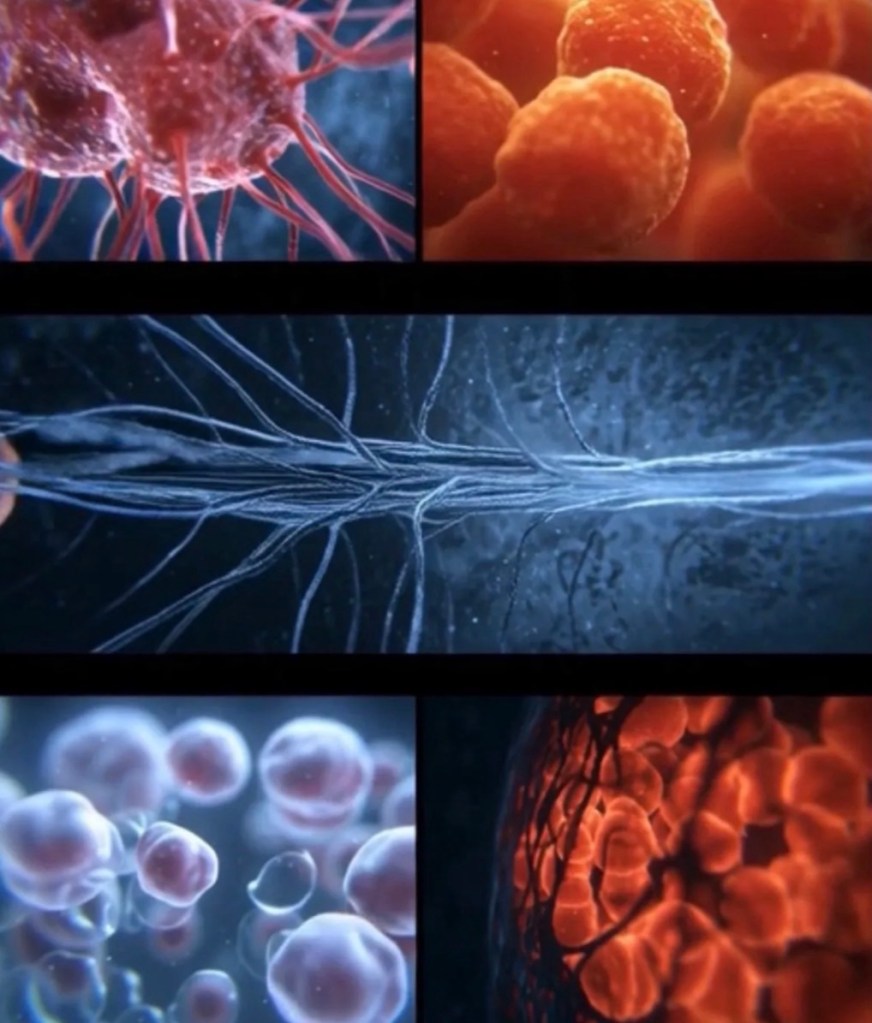
Political analysis: Bubbles ↔ stem cells
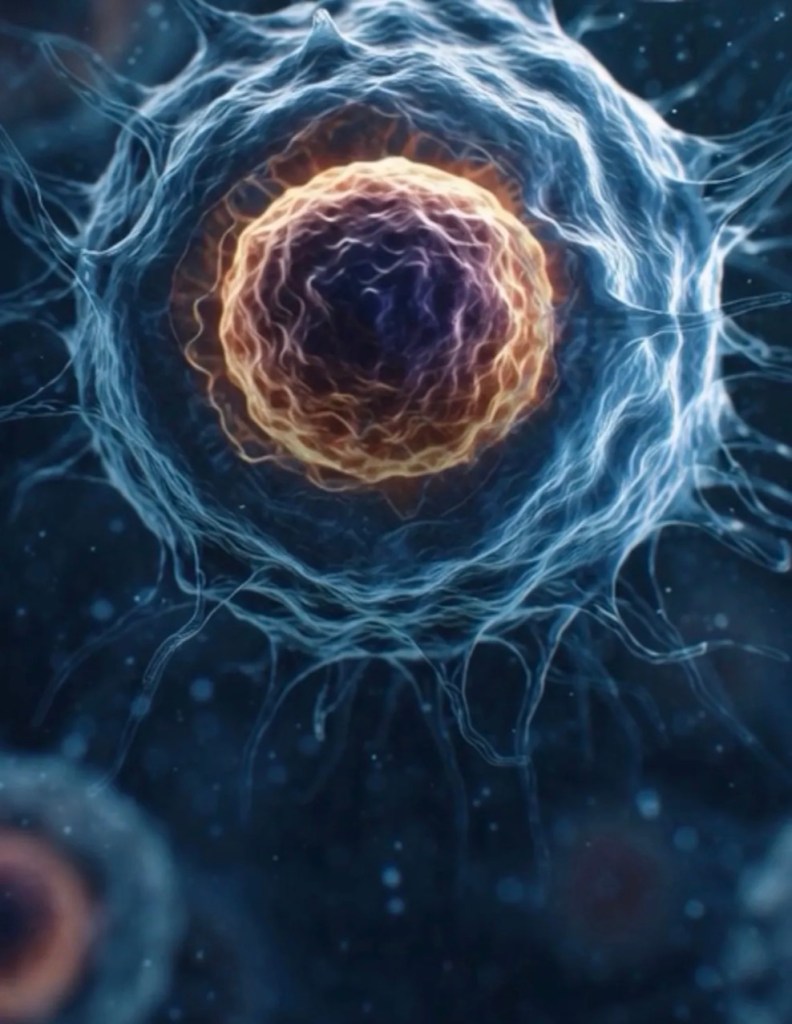
Visually, the “bubbles” echo stem cells in three key ways: containment, potential, and
fragility.Containment / borders Bubbles are membranes: thin, elastic, separating inside from
outside. Stem cells are likewise bounded units whose membranes regulate what
enters and exits. Politically, this mirrors how modern systems manage potential
populations—migrants, youth, innovators—kept within fragile policy “bubbles” (visa
regimes, funding programs, ethical frameworks). Potential without fixed identity A
bubble has no destiny; it can merge, split, or disappear. Stem cells are defined
precisely by undetermined futures. Politically, this resonates with how power
structures treat human potential as a resource: valuable precisely because it is not
yet specified. States, corporations, and institutions compete to shape that potential
before it “differentiates.” Fragility and control A bubble can burst. Stem cells can
mutate or become politically controversial. The imagery suggests a tension: systems
want maximum promise with minimum risk. This is the politics of precaution—
regulate early, contain tightly, intervene before autonomy emerges.
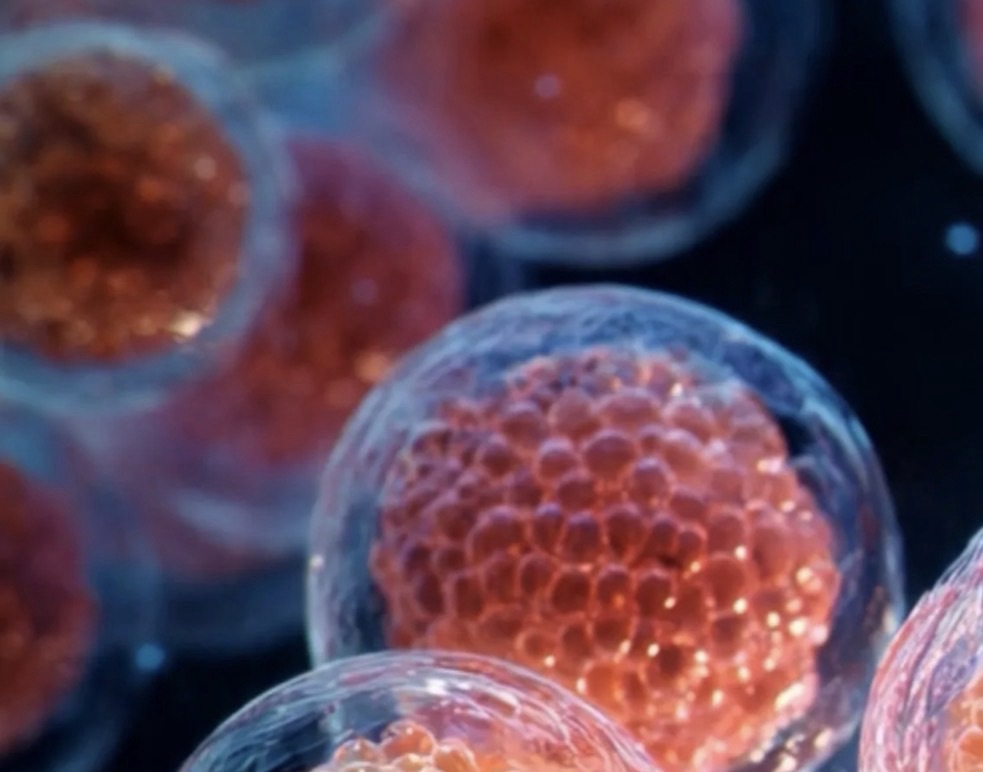
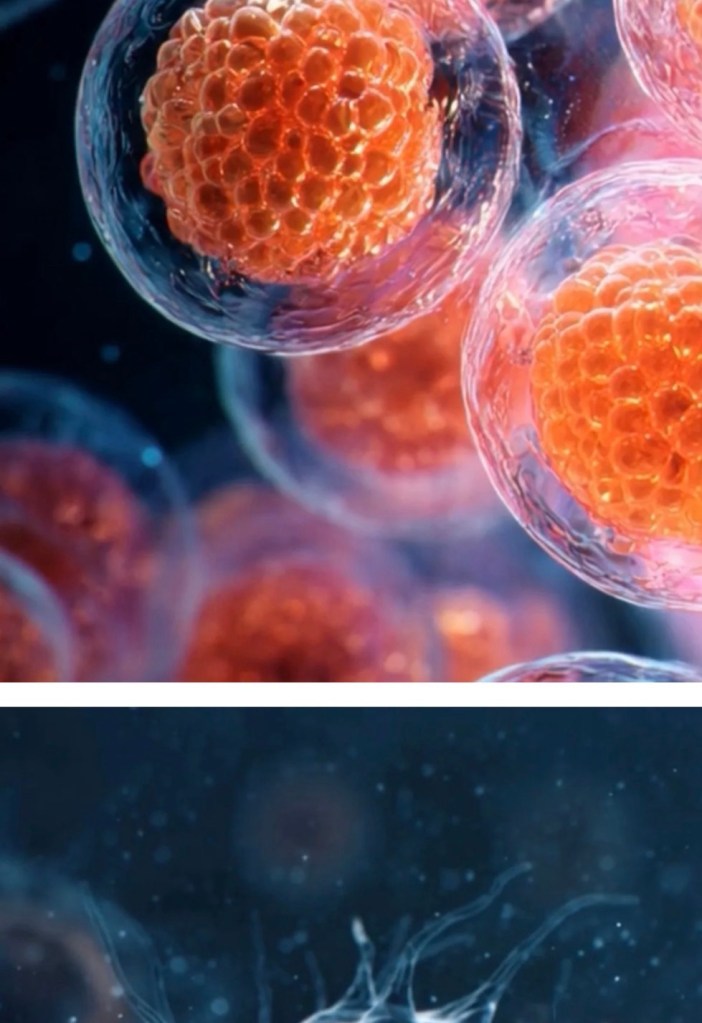
In short: bubbles become a metaphor for how political systems visualize life at its
most exploitable stage—pure promise, carefully enclosed.
Political analysis: Stem cells ↔ politics
Stem cells sit at a rare intersection where biology, ethics, capital, and sovereignty
collide.
Biopolitics (who governs life?) Stem cell research raises the classic political question
Michel Foucault framed: Who has the right to manage life itself? These images—
glowing, isolated cells—feel surveilled, curated, almost administered. Life is no longer
natural; it is governed. Promise economies Politically, stem cells function less as
cures and more as futures. Funding, legislation, and national prestige are built on
what stem cells might do. The imagery’s luminous cores suggest this speculative
value—life as an investment vehicle. Moral borders Stem cells are constantly
crossing moral lines: between life and non-life, human and material, sacred and
instrumental. Politics steps in to draw borders where biology refuses to. The
membranes in these images quietly resemble legal boundaries, not natural ones.
Technocracy vs democracy The abstract, almost cosmic aesthetic distances the
viewer from everyday bodies. This mirrors how decisions about stem cells are often
removed from public discourse and relocated into expert committees, labs, and
policy documents—power without visibility.
3) Reading the work through Farid Nazifi’s trajectory
Given Nazifi’s background—natural sciences → abandoned medical engineering →visual communication + informatics—the work reads as a critique from the inside.
She understands scientific imagery, but refuses its authority. She replaces medical
clarity with ambiguity, aesthetics, and atmosphere. This shift itself is political: moving
from engineering solutions to communicating questions.
The bubbles/stem cells aren’t instructional—they’re destabilizing. They ask:
Who gets to decide what counts as progress? When does life become data? At what
point does care turn into control?
Her personal pivot mirrors the work’s theme: rejecting a purely instrumental view of
life in favor of one that exposes its political entanglements.
Final synthesis
These images argue—quietly but insistently—that:
MODERN POLITICS TREATS LIFE THE WAY
PHYSICS TREATS BUBBLES: VALUABLE,
TEMPORARY, CONTAINABLE, AND
ULTIMATELY DISPOSABLE IF THE SYSTEM
DEMANDS IT.
Stem cells become the perfect political object:
alive, but not autonomous full of promise, but not rights celebrated, yet tightly
governed
Nazifi’s work doesn’t take a side—it reveals the structure. And that, in itself, is a
political act.If you want, I can also:
frame this as a curatorial statement rewrite it in academic theory language
or sharpen
it into a critical manifesto
=Copyright Statement=Copyright Statement=
Congratulations on my e-book release. 📓here you can download the e-book
 Farid Nazifi