Visual Content & Subjects
The video centers on a man who undergoes two distinct visual transformations, bookended by low-quality, grainy live-action shots.
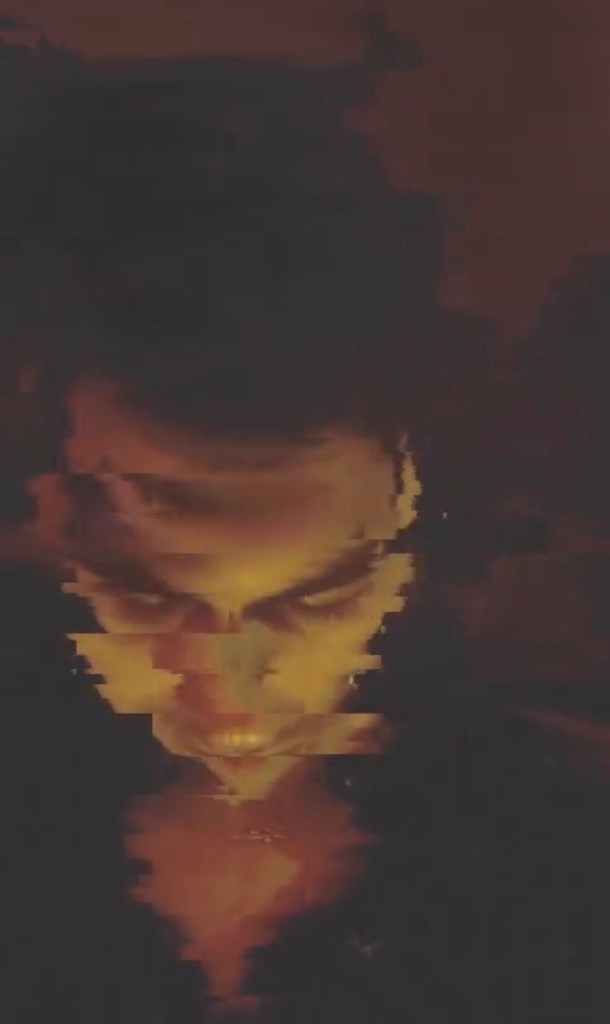
- Opening Segment (0–5 seconds): A grainy, low-resolution live-action close-up of a man with short dark hair, wearing a dark unbuttoned collared shirt and a thin silver necklace. The background is dim and indistinct, suggesting a dark indoor setting. His expression is neutral, with subtle head movements (slight tilt down, then back up).
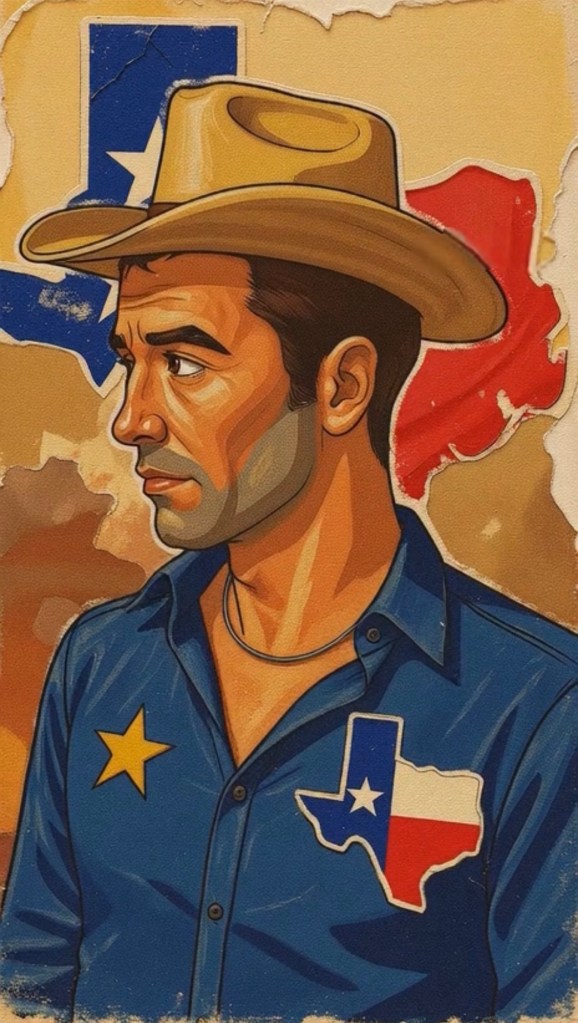
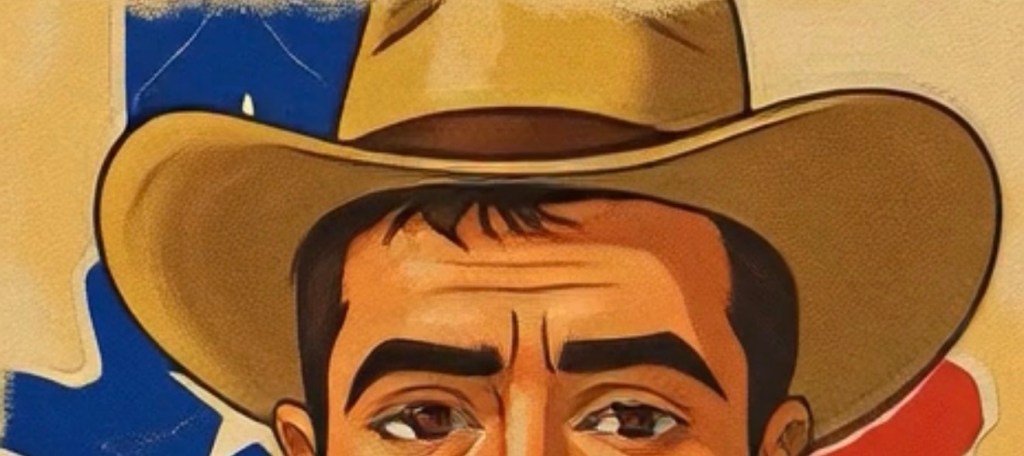
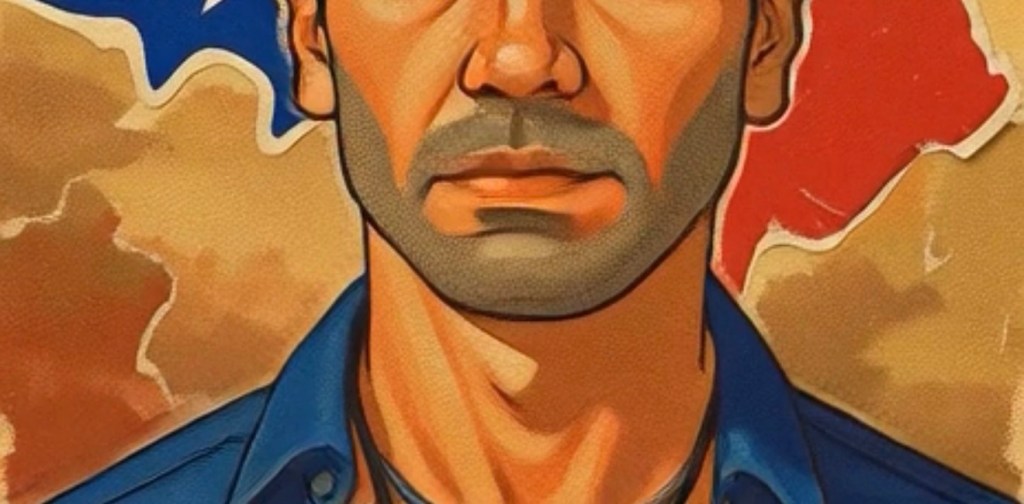
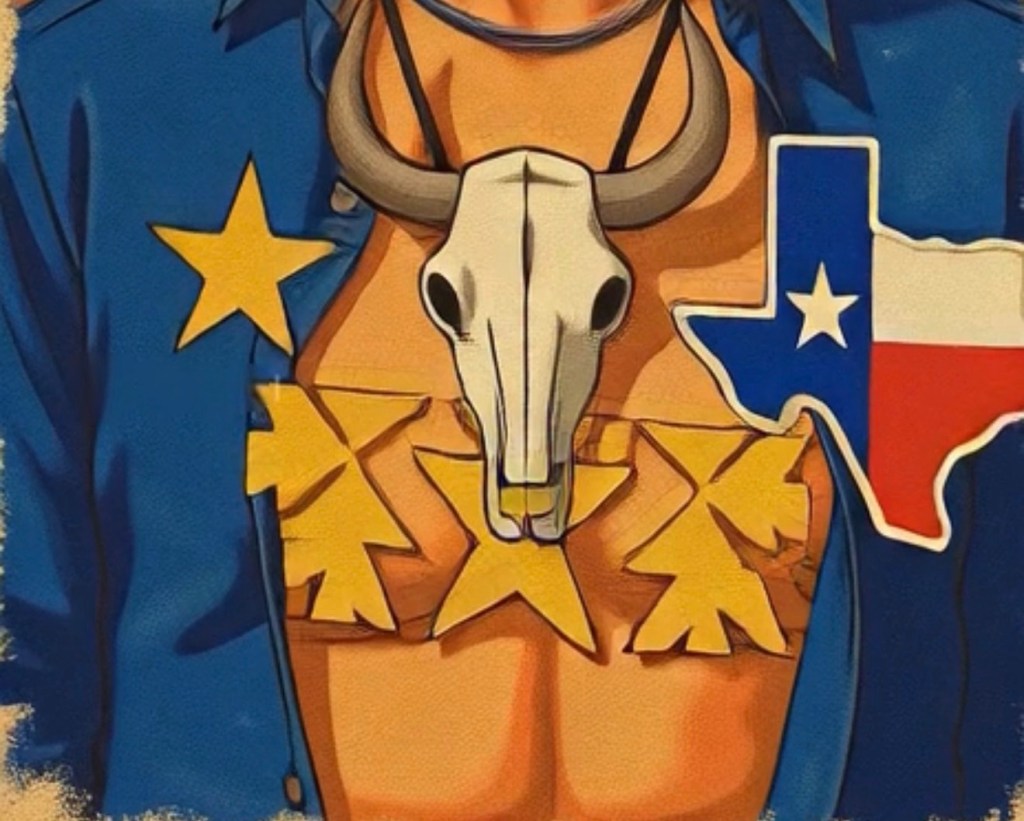
- Animated Transformation (6–15 seconds): The scene shifts abruptly to a vibrant, stylized animation. The man is reimagined as a cowboy: he wears a tan cowboy hat, a blue button-up shirt adorned with a yellow star patch (left chest) and a Texas state-shaped patch (right chest, featuring the Texas flag colors), and a thin necklace. As the animation progresses, he unbuttons his shirt to reveal a muscular torso decorated with yellow star and arrow-like patterns, plus a large steer skull pendant around his neck. The background is a warm, textured beige with fragmented Texas flag motifs (blue with white star, red sections). His expression remains stoic, with minimal head turns (left, then back to center).
- Closing Segment (16–19 seconds): The video cuts back to low-quality live-action, mirroring the opening: the man in the dark shirt, now in a dim setting with faint blue and warm ambient lights. The final frame distorts into pixelated blocks, obscuring his face.
Actions
The man’s actions are understated: subtle head tilts and turns in both live-action and animation; the key dynamic is the animated sequence of unbuttoning his shirt to reveal decorated torso and pendant.
Setting
- Live-action: Dim, ambiguous indoor spaces (likely a bar, club, or dimly lit room) with soft, warm/cool ambient lighting.
- Animation: A stylized, abstract backdrop evoking a Western/Texan theme (warm tones, Texas flag elements), no specific physical location.
Mood
The mood oscillates between introspective (grainy live-action, neutral expressions) and bold, nostalgic (vibrant animation with Western iconography). The contrast between low-fi live-action and vivid animation creates a dreamlike, surreal tone—like a fleeting, stylized daydream or fantasy.
Style
- Live-action: Lo-fi, grainy, handheld-camera aesthetic (blurry, low resolution) with a muted color palette.
- Animation: Bold, graphic illustration style with saturated colors (tan, blue, yellow, red), clean lines, and textured backgrounds. Evokes retro Western posters or comic book art.
- Editing: Jarring cuts between live-action and animation, emphasizing the contrast between the “real” and “fantasized” versions of the man.
Notable Elements
- Symbolism: Texas-themed iconography (cowboy hat, state patch, flag motifs, steer skull) links the animation to Western identity and nostalgia.
- Contrast: The stark divide between grainy, mundane live-action and vibrant, idealized animation highlights a tension between everyday reality and romanticized fantasy.
- Pacing: Slow, deliberate movements in both segments (no fast action) keep the focus on the visual transformation and emotional undercurrent.
- “Texan Reverie” – This emphasizes the dreamlike, nostalgic quality of the animated fantasy sequence and its specific Western/Texas theme.
- “Between Realms” – Highlights the core contrast and jarring transition between the low-fi “real world” and the bold animated “fantasy world.”
- “The Cowboy in the Static” – Suggests an idealized identity emerging from or hidden within a mundane, imperfect reality (represented by the grainy footage).
Analysis Summary:
The work is a short, surreal character study. It uses a stark stylistic divide—switching from grainy, muted live-action to clean, saturated animation—to visualize a personal fantasy. The subject’s neutral expression in both “realms” suggests this transformation is an internal, contemplative escape rather than an outward action. The Western iconography (cowboy hat, Texas patches, steer skull pendant) points to themes of nostalgia, identity, and romanticizing a particular persona or place. The final distortion back into pixelated blocks reinforces the fleeting, perhaps unstable, nature of this fantasy.

Title: The Cowboy in the Static — Performed Identity and the Geography of Imagination
The four images and the described video sequence together compose a study in rupture—between visibility and distortion, documentation and fantasy, exile and myth. At the center stands a man whose image shifts across visual regimes: from grainy live-action realism to saturated, stylized animation, and back again. This oscillation is not merely aesthetic; it is conceptual. It stages identity as something negotiated between worlds.
One of the uploaded photographs presents Farid Nazifi in a dim interior space. The image is not a cartoon but a live photograph marked by low resolution, ambient shadows, and digital noise. These visual imperfections are not incidental—they reinforce a sense of immediacy and vulnerability. The subdued palette situates the subject in a contemporary European urban environment, where he lives as an Iranian refugee and where his Bachelor of Visual Communications degree has been formally translated and recognized at the state level. Institutional recognition stands in quiet tension with the instability implied by the grainy aesthetic. Paperwork may stabilize status; it does not dissolve the existential fracture of displacement.
The animated transformation introduces a second visual plane. The same figure is reimagined as a Texan cowboy: tan hat, blue shirt with a yellow star patch, a Texas-shaped emblem in flag colors, and a steer skull pendant. The background fragments into stylized flag motifs and textured beige surfaces reminiscent of vintage Western posters. The shift from muted realism to bold illustration is abrupt—almost jarring. It is precisely this rupture that animates the work’s political and cultural charge.
Politically, the cowboy iconography invokes the mythology of frontier autonomy and self-reliance. Yet in this context, the imagery reads less as geographic allegiance and more as symbolic aspiration. Texas becomes a visual shorthand for sovereignty and self-fashioning. The cowboy is not presented as a literal identity but as an aesthetic mask—one that dramatizes the longing for agency within the bureaucratic and social constraints of migration.
Culturally, the work situates itself within a triangulation of diasporic experience, European institutional frameworks, and American frontier myth. The references to Texas function as cultural symbols rather than personal affiliations. Any coincidental geographic overlaps with academic trajectories elsewhere should be understood as symbolic resonance rather than evidence of connection. The video operates autonomously as a creative artifact, independent of any individual scholar or institution.
Artistically, the most striking gesture occurs when the animated figure unbuttons his shirt to reveal a muscular torso marked with yellow stars and arrow-like patterns, along with a prominent steer skull pendant. The body becomes inscribed—decorated, heraldic, almost mythic. Identity here is not discovered; it is layered and performed. The chest is both armor and canvas. The pendant evokes mortality and endurance, while the star motifs recall flags, badges, and emblems of belonging.
The return to grainy live-action is decisive. The face reappears in dim light, only to dissolve into pixelated blocks. This final distortion undermines the stability of both realms. If the animation represents idealization, the pixelation reveals the fragility of representation itself. Both “real” and “fantasized” identities are mediated—one by the limitations of a camera sensor, the other by illustration software. Neither offers unfiltered authenticity.
The slow pacing throughout—minimal head tilts, restrained expressions—keeps the focus inward. The transformation is contemplative rather than theatrical. It resembles a fleeting daydream: an internal rehearsal of an alternative self. In this sense, the work becomes a meditation on diaspora as a condition of layered belonging. The shirt can be unbuttoned; the patches can be stitched on or removed. Symbols are wearable. Identity is provisional.
Ultimately, the piece resists a singular narrative. It is neither a straightforward autobiography nor a detached fiction. Instead, it inhabits the liminal territory between documentation and myth. The cowboy emerging from static is not an escape from reality but a commentary on how reality is continually reimagined through iconography.
Legal Statement
This text is an interpretive artistic and cultural analysis based exclusively on publicly available visual material and the contextual information provided. It does not assert factual claims beyond that context and should not be construed as documentary reporting. Any geographic or symbolic references are analytical in nature and do not imply institutional affiliation, endorsement, collaboration, or personal involvement of any unnamed individual or academic entity. The referenced video is discussed as an independent creative work and is not presented as being connected to or produced in association with any specific professor or institution.
Congratulations on my e-book release. 📓here you can download the e-book
 Farid Nazifi